Tuesday, November 07, 2006

Speaking softly

Yesterday I was at church with Elisabeth. As I was getting the bicycle ready for us to leave, Elisabeth started walking toward the front door of the church. I told her not to go outside, and continued to get the bicycle ready.

I saw her continue toward the door, and was preturbed that she was seemingly disregarding my directive. Recently she has been doing much better at obeying the first time I speak, so I was surprised that she continued toward the door. I resisted my instinct to reprimand her, and instead followed her to confront her more directly and quietly.

I found Elisabeth standing out on the front step of the church with a little girl who was probably only 12 or 13 months old. Elisabeth was saying to her, "Stay here. Don't go outside," and keeping her from going down the steps. The front door of the church had been propped open for the custodian to carry out the trash, and the mother of the child was inside the building talking with someone else, and unaware that her child had wandered off. Elisabeth had good reason for going out the door even though I had told her not to - and I had good reason for restraining my tongue, particularly since Elisabeth has been showing more consistency in listening and obedience.

It reminded me that I need to be wise and patient in the way that I confront apparent disobedience and that I want to teach Elisabeth to be a responsible decision maker - like stopping a small child from going into the street, even when I had told her not to go outside.

Monday, November 06, 2006

Reading with Uncle Gordon

Elisabeth enjoyed a recent visit from Uncle Gordon. Among their many activities was a trip to the library. Posted by Picasa

Tuesday

I picked up Tuesday at the library because it was a Caldecott Medal book, but am not overly impressed. I know that the Medal is "awarded to the artist of the most distinguished American Picture Book for Children published in the United States during the preceding year," and clearly on this occasion the Medal was given for artistic quality and not accompanying literary quality. So, if you're looking for pictures, this book will catch your eye. If you're looking for great literature with great illustrations, check out The Man Who Walked Between Two Towers.

Numeration

Elisabeth's numeration skills have improved dramatically over the past few months. Formerly, when counting objects, she would continue to recite the numbers even after we ran out of objects. (Clearly she had the sense of progression, but not of value.) Now she knows to stop when we get to the last object, and that the number on which we end is the total number of objects. She can fairly successfully count objects up to ten, although she sometimes misses an object or double counts one.

What she doesn't yet have is a sense of what the numbers mean - beyond their value. A little illustration may make this plain. It is not unusual that Elisabeth wants the meal to be over before she has finished the food on her plate, so one of us will say to her, "You need to have three more bites," to which she replies,

"No! Four!"

Some things work to our advantage . . .

Sunday, November 05, 2006

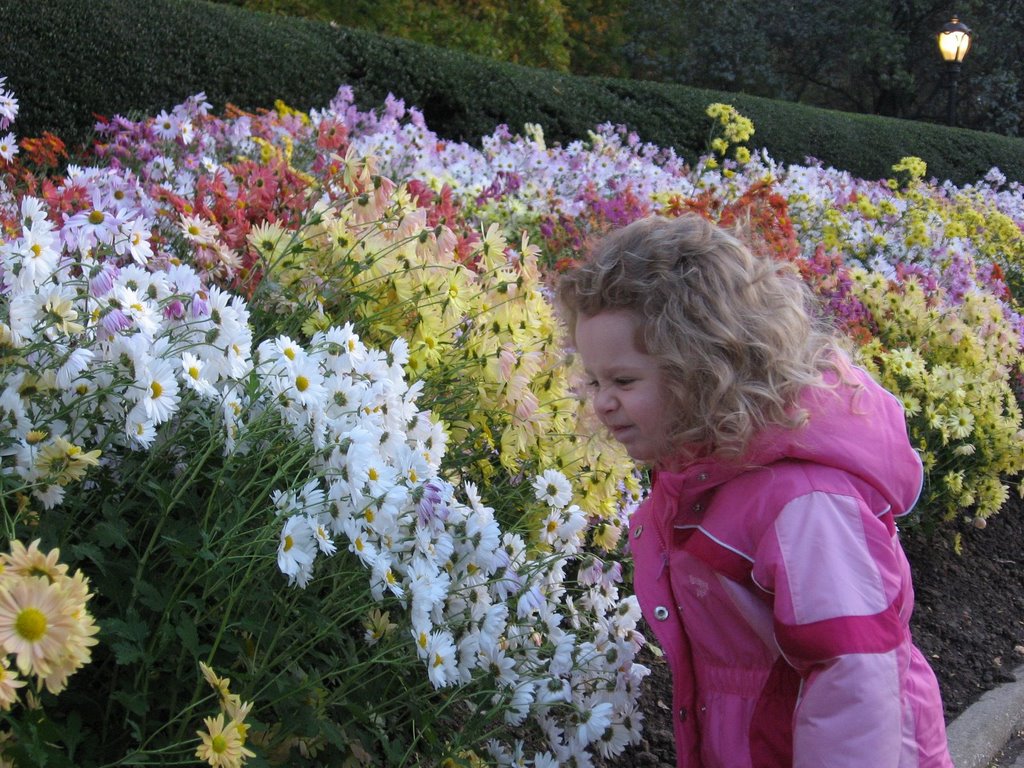
Love that smell

For a long time, Elisabeth thought that one smells by blowing out through the nose instead of inhaling. Although she has now figured out that it works better to inhale, she still makes some adorable faces when smelling. Posted by Picasa

You don't need a baby

Rebecca was talking on the phone with her sister about when we should have another child. Elisabeth overheard the conversation and interrupted:

"You don't need a baby. You have me . . . and I have Penny!"

She might say "no" or "no"

This afternoon we had guests in our home. While Rebecca and I were in the kitchen, Elisabeth was in the living room with our guests. She held a tootsie roll in her both hands and said,

"I don't know if Mommy will let me have this. She might say 'no' or 'no.'"

Saturday, November 04, 2006

Manners

In the past week or so, Elisabeth has begun to say please with her requests without being reminded. (And the parents rejoiced!) Several times each day I find myself saying to Elisabeth, "I am so happy to hear you say please without being reminded!" It truly brings me delight.

But what is that delight? Is it that she uses a particular English word? No. What pleases me is the heart that the word represents. When we present a petition using "please" in English, it signifies that we are appealing to someone without the presumption that we ought to have what is asked. It is a polite way of pleading; it is not groveling, nor commanding, but a respectful way of request.

Yet I have learned in the last two years of Elisabeth's language development that she can very readily use the right words with the wrong attitude. She can say "please" with a plaintive, grating tone, or she can apologize with out a hint of remorse. Manners are far more than saying the right words; but they are not less.

We require of Elisabeth both words and tone of voice. If she speaks politely but forgets the polite word, we ask her to use it (which is finally paying off!) and if she uses the right words, but in a whiny voice, we likewise require her to change her tone before she receives what she asks (which is steadily improving as she learns that right words with a whiny tone doesn't work).

Manners matter because they reflect the heart.

Friday, November 03, 2006

Alphabet order

Last night we had dinner with some friends who also have a young child. They had letter tiles for their daughter, which Elisabeth thought was fantastic. She carried them up to our hostess and said,

"Let's put them in alphabet order."

Though she has had her letters and letter sounds down for quite a while now, I didn't realize that she had the concept of alphabetical order.

Christ for you and for me

Yesterday a friend emailed me this selection from Martin Luther. I love having frinds who send me treasures like this . . . instead of email forwards.

"Returning to the subject which we had begun, I think it is made clear by these considerations that it is not sufficient, nor a Christian course, to preach the works, life, and words of Christ in a historic manner, as facts which it suffices to know as an example how to frame our life, as do those who are now held the best preachers, and much less so to keep silence altogether on these things and to teach in their stead the laws of men and the decrees of the Fathers. There are now not a few persons who preach and read about Christ with the object of moving the human affections to sympathise with Christ, to indignation against the Jews, and other childing and womanish absurdities of that kind.

Now preaching ought to have the object of promoting faith in Him, so that He may not only be Christ, but a Christ for you and for me, and that what is said of Him, and what He is called, may work in us. And this faith is produced and is maintained by preaching why Christ came, what He has brought us and given to us, and to what profit and advantage He is to be received. This is done when the Christian liberty which we have from Christ Himself is rightly taught, and we are shown in what manner all we Christians are kings and priests [by faith, which brings union with Christ the Priest and King], and how we are lords of all things, and may be confident that whatever we do in the presence of God is acceptable and pleasing to Him.

Whose heart would not rejoice in its inmost core at hearing these things? Whose heart, on receiving so great a consolation, would not become sweet with the love of Christ, a love to which it can never attain by any laws or works? Who can injure such a heart, or make it afraid? If the consciousness of sin or the horror of death rush in upon it, it is prepared to hope in the Lord, and is fearless of such evils, and undisturbed, until it shall look down upon its enemies. For it believes that the righteousness of Christ is its own, and that its sin is no longer its own, but that of Christ; but, on account of its faith in Christ, all its sin must needs be swallowed up from before the face of the righteousness of Christ, as I have said above. It learns, too, with the Apostle, to scoff at death and sin, and to say, 'O death, where is thy sting? O grave, where is thy victory? The sting of death is sin, and the strength of sin is the law. But thanks be to God, which giveth us the victory through our Lord Jesus Christ' (1 Cor 15:55-57). For death is swallowed up in victory, not only the victory of Christ, but ours also, since by faith it becomes ours, and in it we too conquer."
[The full text can be found at Project Wittenberg (http://www.ctsfw.edu/etext/luther/freedom/), or in John Dillenberger's Martin Luther : Selections From His Writings.]

What I think Luther captures beautifully is that Christ is "for you and for me." We proclaim not mere historical facts, but we proclaim Christ. The news is received personally as the work of Christ for that person by faith, not mere "facts which it suffices to know as an example how to frame our life." At the heart of the proclamation is a personal, real connection to and fellowship with the King who reigns over all things. Luther is right on: "Who can injure such a heart [joined to Christ], or make it afraid?"

My throat is not feeling well

While working in the living room, I heard a little voice from the kitchen say,

"My throat is not feeling well. I have bad breath."
I had a hunch what was going on, and walked into the kitchen to have my suspicions confirmed. Elisabeth had a Breath Saver mint about two centimeters from her mouth. To her credit, I don't think she was going to eat it without permission, but she was seriously rationlizing her need for a Breath Saver!

Thursday, November 02, 2006

Bathtime

I get excited when Elisabeth takes developmental steps forward. One long-awaited step has been being able to rinse her hair in the bath without much fussing and tears. For a long time Elisabeth has been afraid of rinsing her hair. So we tried a bath visor (which worked intermittently) and rinsing with a washcloth (which satisfied her but did a miserable job of getting the shampoo out).

Now in her last two baths, Elisabeth has been able to lie on her back and look up at the ceiling (without screaming and writhing) so that I can pour water over her hair without getting it in her eyes!

I hope this pattern continues, because it is a massive step forward for her in overcoming fear - and for us in happy bathtimes.

The swimmer

Today Elisabeth took huge strokes forward in swimming. On the first week (in late September) she was afraid to get in the water at all. Today she was motoring around the pool all by herself! She had a float pack on her back, and a "noodle" under her arms - and she swam quite literally all over the pool . . . without holding Daddy's hand! When it came time to jump in from the side, she didn't have to hold my hands in order to jump. She jumped right into my arms and made a tremendous splash! It is amazing the progress that she has made in one month. (I'm an optimistic dad, and I didn't think she'd get this much confidence in so short a time.) Posted by Picasa

Wednesday, November 01, 2006

Climbing

Elisabeth enjoyed the warm weather today with some climbing. Posted by Picasa

The Snowy Day

I have to admit that I only learned this week that The Snowy Day is a Caldecott Medal book. (We have the board book, and it doesn't have the Caldecott symbol on the cover. I turned it over to read the blurb on the back, and there it said that the book had won a Caldecott.) It prompted me to look more closely at the illustrations, and to realize just how unique and good the book is.

If memory serves me correctly, The Snowy Day was one of the first children's books (or perhaps pictures books?) published in this country that had a black boy as the protagonist. As such, I think it is an important book (not to mention an enjoyable one) because it set a precedent for using literature to put forth positive norms for young black boys.

Having taught in a public school where virtually all of my students were black, I have a special tenderness for black boys - especially the "bad" ones. And so I especially love books that provide good role models - not just for children generally, but for black children. For a black child to read a story about a white protagonist is analogous to a white child reading a book in which the protagonist is a Mongolian child. The protagonist is of a different race and culture. One can admire the other, but can't as readily identify with that person.

Soon I'll post on The Story of Ruby Bridges, which is far and away my favorite non-fiction children's picture book (in which the protagonist is a black girl).

So if you know of excellent children's literature with young black protagonists, please add them to the comments here!

Tuesday, October 31, 2006

A new set of wheels

Pop-pop (Elisabeth's grandpa) gave her a two-wheeler with training wheels at the beginning of the summer. Sadly, it was stolen. Pop-pop, undeterred, found a used bike that was being discarded. He fixed it up (and added streamers) and brought it to Elisabeth today. So she's rolling again!

Roasted Fall Vegetables

We've tried this recipe a couple of times now (and again tonight), and it is delicious and healthy!

You must say

Today Pop-pop came to visit Elisabeth (and to bring her a bicycle that he refurbished after her previous one was stolen). While they were sitting together on the couch reading a book, he asked Elisabeth, "Can I have a hug?" Elisabeth replied,

"You must say: 'May I please have a hug . . . in Spanish!'"
Even we don't make her ask in Spanish!

Monday, October 30, 2006

Wearing the kid-pack

Usually I'm the one wearing Elisabeth, but recently she decided that she fit just as well in the harness as in the carrier. She snapped herself in, and was even able to get it off the ground! Posted by Picasa

Turning the tables

The question with which I am wrestling [...] is this: As people who are part of modern Western culture, with its confidence in the validity of its scientific methods, how can we move from the place where we explain the gospel in terms of our modern scientific worldview to the place where we explain the modern scientific worldview from the point of view of the gospel?
(Weston, Paul. ed. "Lesslie Newbigin: Missionary Theologian." Grand Rapids, MI: Eerdmans. 2006 p199)

That this question is so rarely asked is strong evidence that in many ways our thought, even about proclamation, is shaped far more by our culture than by the gospel. That Newbigin asks it so clearly and forcefully is a good indicator that he was on the pursuit of a truly missionary encounter with Western culture that had the gospel as its foundation - and we would do well to learn from him.