Handwriting
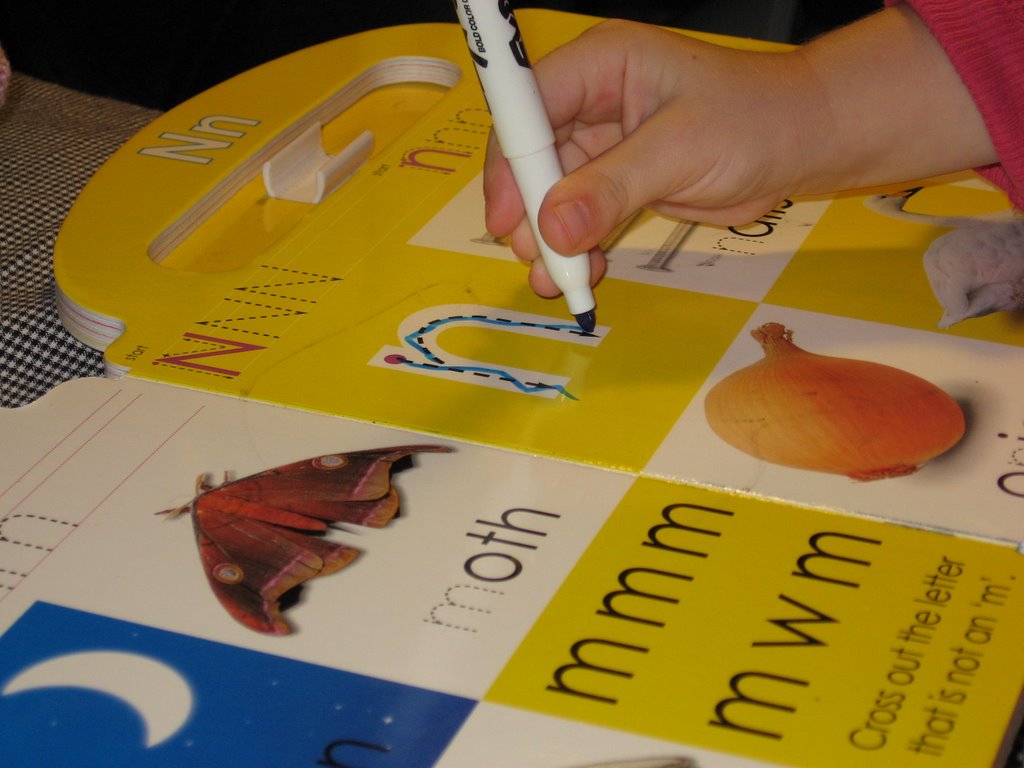
Elisabeth has a newfound fascination with writing (to the delight of her parents). She shocked us by actually being able to follow the lines. So now we carry our wipe-clean book wherever we go!
“Now I do not mean to affirm that in all cases there need be the preaching of false doctrine which involves an open and direct denial of the evangelical truth. It is quite possible that both to the intention and the actual performance of the preacher any departure from the historical faith of the church may be entirely foreign. And yet there may be such a failure in the intelligent presentation of the gospel with the proper emphasis upon that which is primary and fundamental as to bring about a result almost equally deplorable as where the principles of the gospel are openly contradicted or denied. There can be a betrayal of the gospel of grace by silence. There can be disloyalty to Christ by omission as well as by positive offence against the message that he has entrusted to our keeping. It is possible, Sabbath after Sabbath and year after year, to preach things of which none can say that they are untrue and none can deny that in their proper place and time they may be important, and yet to forgo telling people plainly and to forgo giving them the distinct impression that they need forgiveness and salvation from sin through the cross of Christ’ (Grace and Glory, 237-238).” (82, footnote 211) (HT: Justin Taylor)
This selection from The Letters of Geerhardus Vos captures what I have been thinking and feeling for some time. One can preach "things of which none can say that they are untrue" without preaching the Gospel. Not only so but "the result is almost equally deplorable as where the principles of the Gospel are openly contradicted or denied."
An emphasis on what is primary, central and essential, accompanied by an utter dependence on the Holy Spirit to give life to dead people through the faithful presentation of this message is absolutely essential. The absence of these two conditions (right emphasis, complete dependence) perpetuates spiritual death, because the absence of either openly contradicts or denies the principles of the Gospel.
We speak of the Copernican revolution as that change which challenged the prevailing European notion that the world was the center of the solar system, and suggested instead that the Sun was that around which the earth and other bodies orbit.
I believe that I am undergoing a Newbiginian Revolution which is challenging my prevailing notion that reason forms the center of our cognitive system, and contending instead that God is the center - without whom there is no reliable knowledge.
For an outstanding treatment of the Enlightenment, its effects on western society, and the church in particular, check out Leslie Newbigin: Missionary Theologian.
Recently I have been thinking much (not only with regard to worship) about knowledge. Knowing of a person requires the Knower, and the Known. Jonathan Edwards has helped me to see more clearly the relationship of subject and object, and how we glorify God in worship:
God is glorified not only by His glory's being seen, but by its being rejoiced in. When those that see it delight in it, God is more glorified than if they only see it. His glory is then received by the whole soul, both by the understanding and by the heart. God made the world that He might communicate, and the creature receive, His glory; and that it might [be] received both by the mind and heart. He that testifies his idea of God's glory [doesn't] glorify God so much as he that testifies also his approbation of it and his delight in it [Jonathan Edwards, The "Miscellanies," ed. by Thomas Schafer, The Works of Jonathan Edwards, vol. 13, ed. Thomas Schafer (New Haven, Conn.: Yale University Press, 1994), 495]It is the last line (which I have bolded) that has been immensely helpful to me. It is the difference between stating the worth of Jesus Christ as an idea, and as that which has taken control of our hearts. The latter always implies (if it does not explicitly state) the subject, me. "You are altogether lovely to me" speaks not only the objective beauty of Christ, but of its power to fill and transform the subject, me. There are two ways to hear the same phrase. One is parochial, confining beauty to what I can see: "You are lovely to me . . . and I am the judge who decides what is lovely." The other is God-entranced: "You are lovely to me . . . because You have awakened my heart to behold and love Your beauty, of which I see but a ray."
True maturity is being able to deal with immature people in ways that are gentle, loving, firm and genuinely help them to mature. Such maturity is most pronounced when it is seen in times of crisis.
Recently I have come across The Rebelution, a blog by a couple of 17 year-old twins, who have remarkable depth for their age. They have been a great reminder to me of the depth and maturity that can be present in teen-agers, despite what our culture says.
HT (Justin Taylor)
Growing up, my parents read to us daily from Operation World, the Bible, and a missionary biography. I remember loving it, and now I want to share that joy with Elisabeth. However, I've been mindful that she's only two, and I'm inclined to be overeager. So it was with great joy that I recently saw how Elisabeth's natural abilities and interests intersect with my desire to teach.
Elisabeth loves maps, and has a remarkable spatial awareness. She can find and name somewhere between 6 and 12 countries on a world map, and can point to ask many places and say, "_____ lives there." Just this week I realized that since Operation World highlights one country each day, it would be perfect for connecting with her little laminated map. I can tell her the place, a little bit about it, and mention anyone we know who lives there - and then she can have the joy of finding and naming it on the map! So this week she has discovered Norway, Oman, and Pakistan!
Last night we had a strategic planning meeting for our church. We closed with the early evening prayer from the Book of Common Prayer:
O Gracious Light,
pure brightness of the everliving Father in heaven,
O Jesus Christ, holy and blessed!
Now as we come to the setting of the sun,
and our eyes behold the vesper light,
we sing your praises O God: Father, Son, and Holy Spirit.
You are worthy at all times to be praised by happy voices,
O Son of God, O Giver of life,
and to be glorified through all the worlds.
Reading:
It is not ourselves that we proclaim; we proclaim Jesus Christ as Lord, and ourselves as your servants, for Jesus' sake. For the same God who said, "Out of darkness let light shine," has caused his light to shine within us, to give the light of revelation - the revelation of the glory of God in the face of Jesus Christ. 2 Corinthians 4:5-6
Elisabeth has been resisting naps for the last week or so, which has left me without the afternoon time to which I've been acustomed to work, blog and email.
Does anyone have suggestions on how to help a toddler self-soothe to sleep in the early afternoon?
At present, I can't get any pictures to load on Blogger, which means no shots of Elisabeth. Sorry! As soon as they get it fixed, I'll put some up.
John Bunyan was imprisoned for preaching the gospel, and would have been released, if only he would consent not to preach. Bunyan had four children under the age of ten when he was imprisoned, one of whom was blind; their mother had little means to care for them with their father imprisoned. Yet he would not consent not to preach, and his wife, though severely strained by that choice could not have given him a stronger support. In 1661, she went to the authorities to plead again for his release, and this was their exchange:
"Would he stop preaching? "
"My lord, he dares not leave off preaching as long a he can speak."
"What is the need of talking?"
"There is need for this, my lord, for I have four small children that cannot help themselves, of which one is blind, and we have nothing to live upon but the charity of good people."
Matthew Hale with pity asks if she really has four children being so young.
"My lord, I am but mother-in-law to them, having not been married to him yet full two years. Indeed, I was with child when my husband was first apprehended; but being young and unaccustomed to such things, I being smayed at the news, fell into labor ,and so continued for eight days, and then was delivered; but my child died."
Hale was moved, but other judges were hardened and spoke against him. "He is a mere tinker!"
"Yes, and because he is a tinker and a poor man, therefore he is despised and cannot have justice."
One Mr. Chester is enraged and says that Bunyan will preach and do as he wishes.
"He preacheth nothing but the word of God!" she says.
Mr. Twisden, in a rage: "He runneth up and down and doeth harm."
"No, my lord, it is not so; God hath owned him and done much good by him."
The angry man: "His doctrine is the doctrine of the devil."
She: "My lord, when the righteous Judge shall appear, it will be known that his doctrine is not the doctrine of the devil!"
Bunyan's biographer comments, "Elizabeth Bunyan was simply an English peasant woman: could she have spoken with more dignity had she been a crowned queen?" Source
I want to live like the Bunyans, in utter integrity, believing that this Good News is more to be valued than freedom, comfort, and life
Today was my first time streaming video on the new Desiring God website. (I've found it well done, and well organized.) In Piper's sermon last Sunday, he says,
You cannot be a loving person and not want your life to count for reaching unreached people. It is pure hypocrisy to say, "I love human beings," and do nothing in your life, have no increment of ambition, to see that the gospel reach people who don't know Him.That is to say, the Gospel of necessity transforms our hearts with love for God and love for people such that we desire God to be glorified in the glad submission of all people, and we want other people to taste of the beauty and joy that are found truly and only in God.
Elisabeth has picked up on the fact that when we part from friends, we often say,
"Have a good ___ (afternoon, evening, etc.)"She has also realized that the other person usually says, "We will."
"Have a good noon we will!"and bursts into laughter (because we do).
This Sunday I preached on John 6:35-51 and developed this theme: The Triune God is our salvation; He shatters our pride in order to give us unshakeable hope in Him.
There is no question to me as I prepared that God intended me to not only deliver this message, but to embody it - having my pride shattered in order to trust truly in Him. Being broken is grace, when He does it to us.
Recently a fellow parent-blogger pointed me to a couple of excellent resources on blogging. Bob Kauflin writes on Blogging to worship God and Suzanne Hadley writes on Blogging Responsibly.
The articles challenged me to dig deeper with some more substantial reflection, which I look forward to doing. Now that Blogger has enabled Labels, those who just want Elisabethisms can go straight there, or the latest Photos, and those who want to see what I'm digging through can dig with me. (My apologies for the foibles of Blogger Beta. The labels don't work perfectly, and neither does the search, but I think they're working on it.)
"I would willingly exchange my learning for the tinker's power of touching men's hearts." (John Owen, to King Charles, on why he went to hear John Bunyan, an uneducated 'tinker', preach.)O how I resonate with Owen - and I don't even have any great learning to renounce in exchange for that power!
I did often say before the Lord, that if to be hanged up presently before their eyes would be means to awake in them and confirm them in the truth, I gladly should consent to it. (DG)
One real view of the glory of Christ, and of our own concern in it, will give us a full relief in this matter. For what are all the things of this life? What is the good or evil of them in comparison of an interest in this transcendent glory? When we have due apprehensions of this, when our minds are possessed with thoughts of it, when our affections reach out after its enjoyments, let pain, and sickness, and sorrows, and fears, and dangers, and death, say what they will, we shall have in readiness wherewith to combat with them and overcome them; and that on this consideration, that they are all outward, transitory, and passing away, whereas our minds are fixed on those things which are eternal, and filled with incomprehensible glory. (Owen, John. "The Glory of Christ." Glasgow: Christian Heritage. 2004. p30)



 Subscribe to posts


