Sunday, June 25, 2006

I'm giving Mommy a hard time

Recently at a friend's house, Elisabeth perched on their couch in a "Moses' basket" (a woven bassinet for an infant). Elisabeth, in her excitement, nearly dumped the basket and its contents (herself) onto the floor. My wife jumped to her aid and kept her from falling. She said, "You almost gave Mommy a heart attack!" Elisabeth grinned and said,

"I'm giving Mommy a hard time."
Close enough.

To gladly spend


Yesterday, after a brief morning outing, as I returned to our block, I saw a bookshelf on the sidewalk with a sign: $29. I hastily crossed the street to look more closely, and realized that it was identical to an oak bookcase that we have in our livingroom/dining room/library/guest room. (You who have stayed with us can smile.) A young woman (the owner of the bookcase) was sitting in a moving truck nearby, waiting for the next load of goods. I quickly told her that I wanted the bookcase, and that I would go to talk to my wife and get the cash to pay for it. I did exactly that: I ran upstairs, talked with my wife and got the money. I was eager to part with $29 for a beautiful oak bookcase (identical to our other one!).

That experience made me think of the parable of the treasure hidden in the field, and that of the pearl merchant. They were glad to spend, in order to obtain something of great value. Just as glad as I was to part with $29 for a great bookcase, I should be more so, with even more joy, to part with everything for the sake of the Kingdom. This is the kind of love for God that enables joyful, sacrificial service like Paul's for the Corinthians:

I will most gladly spend and be spent for your souls. (2 Corinthians 12:15)
God, give me eyes to see the beauty and treasure of Your Kingdom!

He ate some playdough or something


On Friday we had dinner with good friends who are expecting their first child in about a week. They had been given Baby Faces, a board book with pictures of babies' expresions. Elisabeth looked at one unhappy face and exclaimed,

He ate some playdough or something!


Pushing swings is just as fun as swinging! Posted by Picasa

I want cookies!

Last night my in-laws spent the night with us, so they slept in our bed, and we slept in the loft over Elisabeth's toddler bed. Some time in the middle of the night we heard these words emerge from our sleeping (or half-awake?) toddler:

I want cookies!
We didn't get up in response, and thankfully, neither did she.

Saturday, June 24, 2006


In the gardens Posted by Picasa

What better preparation?

This, therefore, deserves the severest of our thoughts, the best of our meditations, and our utmost diligence in them. For if our future blessedness shall consist in being where he is, and beholding his glory, what better preparation can there be for it than in a constant previous contemplation of that glory in the revelation that is made in the Gospel, to this very end, that by a view of it we may be gradually transformed into the same glory? (Owen, John. "The Glory of Christ." Glasgow: Christian Heritage. 2004. p24)
A sight of what we were made for, being where He is, and beholding His glory, will teach us how to live, and prepare us to die.

Friday, June 23, 2006


In a pink hat Posted by Picasa

Study the character of Christ

Let us, at the very commencement of our meditations, admit that there is nothing so natural to man, nothing so insidious and hidden from our sight, nothing so difficult and dangerous, as pride. Let us feel that nothing but a very determined and perservering waiting on God and Christ will reveal how lacking we are in the grace of humility, and how impotent we are to obtain what we seek. Let us study the character of Christ until our souls are filled with the love and admiration of His lowliness. And let us believe that, when we are broken down under a sense of our pride, and of our impotence to cast it out, Jesus Christ Himself will come in to impart this grace too as a part of His wondrous life within us. (Murray, Andrew. "Humility: The Beauty of Holiness." Fort Washington, PA: CLC Publications. 1997. p16 )
The way to humility is not by looking at ourselves, to see if we've got it, but to wait on God, study the character of Christ, and believe that Christ has the power to overcome our impotence to overcome pride.

Music and Memory

Recently I have been working to re-memorize a long passage that I memorized two years ago. In the process I have been reminded of the mental work required to memorize, and that the more you do, the easier it gets. I've also been amazed at how putting something to music makes memory so much easier.

In that realm, we have come across a fantastic resource for children: Hide 'Em in Your Heart Songs, recorded by Steve Green. Not only do the tunes help kids (and parents) to memorize, but the selections of Scripture are very well-chosen and appropriate. If anyone has suggestions of Scripture set to music for kids, I'm all ears!

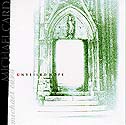
(For grown ups, Michael Card does a fantastic job of retelling entire books of Scripture in his songs. One of my favorite albums is Unveiled Hope, a summary of Revelation.)


Thursday, June 22, 2006

(Snap) (Snap) "Daddy!"


This morning I went for a run before my wife and daughter woke up. I walked into our home as quietly as I could. As I did, I heard a faint sound:

(Snap) (Snap) "Daddy!"
Elisabeth had gotten out of bed, walked into the kitchen, climbed in her high chair, snapped herself in (the two snaps I heard), and was ready for her breakfast - whether or not Mommy and Daddy were out of bed or back from running!

Red State Promise

Touchstone has a very interesting article on kids and culture. The author, a teacher in a charter school in Colorado, contends that there is a strong breed of young people who are rejecting the tolerance they have been told is right. These students he identifies as "red-state students" who come from "the culture that deliberately embraces traditional morality, principally based in the Christian faith, most prevalent in, but not confined to, the “red states.”"

As someone who lives in a blue state and has taught in the public schools, I began to have questions. What is our hope? Is our hope that red state morality ("Judeo-Christian values") will prevail in our country?

The author, in describing one of his students says,

"In short, she wants to give to her children the same things her parents gave to her, the important things: safety, education, faith, family."
I cannot help but notice that safety came first in that list. Having just listened to the testimony of Steve Saint, whose father was martyred in Eduador by a tribe that had a 60% (yes, that's right) homicide rate, there is a profound dissonance. Steve Saint has witnessed a glorious, profound turning of this tribe to Jesus that came through his parents' choice to go to the dangerous places to share the good news. Steve Saint has picked up on what his parents gave to him, the important thing: Christ, and for His sake, family and education.

I am glad that kids are rejecting relativism; I'm glad that they're not sleeping around; I'm glad that they're reading the classics, and that they see the aesthetic emptiness of much of what passes for 'art.' Yet my hope is not that we will become a moral 'red state' society, but that Christ will be all in all - in all the nations.

Entire Nothingness

[Humility] is not something we bring to God, . . . it is simply the sense of entire nothingness which comes when we see how truly God IS ALL, and in which we make way for God to BE ALL. (Murray, Andrew. "Humility: The Beauty of Holiness." Fort Washington, PA: CLC Publications. 1997. p14 )

Outsourcing Torture

In the past year, I have been particlarly appalled at our government's refusal to stop the practice of transferring prisoners to countries with histories of torture. When there was abuse in Iraq, the military disciplined those involved; however, there has been no change of course on our policy of "extraordinary renditions" and I have heard no other feasible explanation for the practice than this: other countries will do things to prisoners that we wouldn't do on our own soil.

So I would encourage you to read Amnesty's information on Air Torture, and if you find it persuasive (as I have) use their site to email our President and your representatives in Congress asking them to end this practice.

Wednesday, June 21, 2006

Christian nirvana

In The Finality of Christ, Lesslie Newbigin presents two contrasting pictures of religion.

Although the wheel is a human construct, it is a powerully evocative symbol of the natural world as man experiences it. The cycle of birth, growth, decay and death through which plants, animals, human beings and institutions all pass suggests the rotating wheel - ever in movement yet ever returning upon itself. The wheel offers a way of escape from this endless and meaningless movement. One can find a way to the centre where all is still, and one can observe the ceaseless movement without being involved in it. . . .

The other symbol is the road. History is a journey, a pilgrimage. We do not yet see the goal, but we believe in it and seek it. The movement in which we are involved is not meaningless movement; it is movement toward a goal. The goal, the ultimate resting-place, the experience of coherence and harmony, is not to be had save at the end of the road. (Weston, Paul. "Newbigin, Lesslie Missionary Theologian: A Reader." Grand Rapids, MI: Eerdmans. 2006. p55)
It struck me in reading this that although Newbigin was contrasting eastern religion (Buddhism and Hinduism) and western religion (Christianity and Judaism), much of Christianity has lost hold of the distinctive historical rootedness of the faith. We attempt to offer a Christian version of nirvana, in which the soul is presently at peace - when this is not at all what Jesus came to do. His entry into history, establishing the climax of history at the cross, was for a historical purpose: that all things are going to be brought under His feet in time and space. All existence points to that time when He will be all in all. Thus His call, "Follow me," is not to escape the pain and confusion of this present age, but to give unspeakably profound meaning to the suffering, in the midst of perplexity, as we look forward to, and speed the return of our King. This is the present blessedness of real future hope:

Blessed are you who are poor, for yours is the kingdom of God.
Blessed are you who are hungry now, for you shall be satisfied.
Blessed are you who weep now, for you shall laugh.

Blessed are you when people hate you and when they exclude you and revile you and spurn your name as evil, on account of the Son of Man! Rejoice in that day, and leap for joy, for behold, your reward is great in heaven; for so their fathers did to the prophets. (Luke 6:20-23)

Planning

I find myself very ambivalent with regard to planning. Jesus both commends and condemns it. Of the one who started to build without planning for the cost, Jesus said he would be mocked by everyone. Yet the one who planned so well as to store up for himself for years to come Jesus also reproved.

I think there is something important to be learned with regard to planning and parenting in the gospel. If we set about parenting without a plan of how to do it, we are surely those who deserve mockery. Yet if we have a plan, and are confident in our plan, we are just as foolish. It seems that there is a sort of planning that is required that weighs the costs, sets a course, and yet trust in God rather than the plan.

There are quite literally hundred of daily things in which I see this. If I do not have a plan for how to teach Elisabeth the history of salvation, and the commands of God, it will not happen. But if I trust my ability to plan, structure and teach, I dishonor the Holy Spirit, who is the only true teacher.

I think it is fair to say that planning can be an expression of trust, or of arrogance; lack of planning does not demonstrate trust, but folly. We must plan under the hand of God, and be ready for Him to redirect us at any time.


How to eat strawberry shortcake Posted by Picasa

There is no want . . .

Elisabeth has a habit of saying, "I want . . ." or "I need . . ." and forgetting to say please. I seem to remember a line from the Karate Kid where Mr. Miagi said something like, "There is no do; there is only try." Inspired my Mr. Miagi, I have a habit of responding to Elisabeth:

"There is no want; there is no need; there is only May I please have . . ."

I want ibuprofen

Yesterday after having napped for an hour and fifteen minutes, Elisabeth walked out her room and said,

"I want ibuprofen."
She's getting her two year molars, so her mouth is constantly hurting, and she has learned that the chewable ibuprofen tabs make her mouth feel better. Smart kid.

Tuesday, June 20, 2006

Teaching code switching

We're at that stage where we need to intentionally teach Elisabeth how to address adults. In that process, I have observed (and remembered) that children learn to code switch. What I mean is this: If a child is taught to address adults generally as Mr., Mrs., and Miss (Last name), and closer family friends as Mr., Mrs. and Miss (First name) or Auntie and Uncle (First name), she or he will pick up on the fact that adults do not address each other in this way. This is not only good, but important. It means that they will learn that different rules of interaction apply to different people. So, when I say, "I'm going to call Jeremy," it is most natural for her to reply, "Daddy, why are you going to call Uncle Jeremy?" She is perceiving that the relationship between Daddy and Jeremy is different from the relationship between Elisabeth and Jeremy.

I am not saying that there is one way, regardless of culture, for children to address adults. I am saying that it is important to teach respect for elders in the ways that children address adults, and that asking them to address adults in ways different than Mommy and Daddy do is not only appropriate (and possible!) but also helpful.

Monday, June 19, 2006

Suffering, Sovereignty and Parenting

Today as I pushed Elisabeth about town in her stoller, I listened to Steve Saint on Sovereignty, Suffering and the Work of Missions, part of the Desiring God national conference: Suffering and the Sovereignty of God.

As I listened, I wept. Steve Saint's father, Nate Saint, was martyred in Ecuador when Steve was only 5 years old. Steve lost his own daughter to an untimely death. Through it all, he magnifies the sovereignty of God in the way that it sustained him in and through those events. I highly recommend this as a lesson in true parenting - and missions.


Out for a walk . . . Posted by Picasa

I want to show Penny where Changchun is

In response to Elisabeth's question, "Where is Afghanistan?" we put up a world map in her room. Now she can locate Afghanistan, Pakistan, Kazakhstan, and China. (We have friends in Afghanistan and China; my dad is presently in Pakistan, and my brother is currently in Kazakstan, so each country has a personal connection.)

One of our friends in China lives in Changchun. So Elisabeth has been very excited not only to be able to locate China, but Changchun within China.

The best way to reinforce knowledge is to teach others . . . so during her 'nap' time, I heard Elisabeth say,

"I want to show Penny where Changchun is."
Soon both Elisabeth and Penny (her favorite doll) will know where Changchun is.

Living like Jesus in front of our kids

Jesus called Levi from his tax booth to follow Him. Levi not only left everything to follow Him, but then made a great feast for his new Master at which was "a large company of tax collectors" (Lk 5:29) Not surprisingly, this offended the religious Jews, who perceived holiness as keeping away from the dirty ones. Jesus responded:

"Those who are well have no need for a physician, but those who are sick. I have not come to call the righteous but sinners to repentance" (Luke 5:31-32).
Do we imitate Jesus in this? Do we live among the 'sick', the despised tax collectors 'and sinners' - not because we embrace their sin, but to call sinners to repentance? Or do our kids see parents who simply keep their noses clean, and look down on the sinful folk? Or do they see parents who are among the sinners, but aren't calling anyone to repentance?

If our kids are to grow up in the holiness of the Son of God that is neither stuffy nor indulgent, we must model the way of socializing with the 'sick', and calling them out of sickness and into repentance.

I had a good nap, Daddy.

Elisabeth just walked out of her room and said to me,

"I had a good nap, Daddy."
The fact is, she's been on her bed, but she hasn't napped yet. I think perhaps she thought that because she had been quiet for 5 or so minutes that she had been asleep (or that I would think she had)!

Sunday, June 18, 2006


Playing at the park makes a girl tired! Posted by Picasa

Where is she?

This morning Rebecca and I tiptoed through Elisabeth's room so as not to wake her up, only to see an empty bed! We continued through her room into the living room to find our toddler curled up on the couch.

I'm glad the lock on the front door is still out of reach.

I want some of that from that man

Tonight, as we walked past an ice cream vendor on the street, Elisabeth pointed and said,

"Daddy, I want some of that from that man."
We wondered how long it would be before she would be fully aware of what they sell. That time has come . . .

Mommy, my nose is crying

For the last two days or so, Elisabeth has been teething (2-year-old molars) and has had the accompanying runny nose. Today she turned to Rebecca and said,

"Mommy, my nose is crying."

What an apt description.

Saturday, June 17, 2006


Mommy's Sweeties (posted by Rebecca)- bedtime at our house. Posted by Picasa


From the Elisabeth Archives... Posted by Picasa

Friday, June 16, 2006


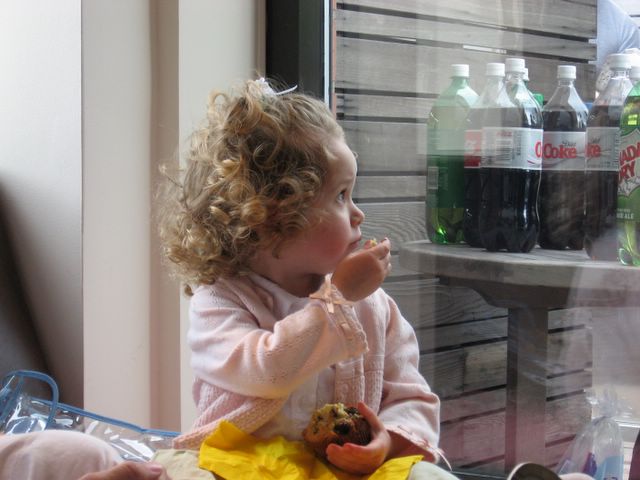
Is that Diet Coke? Posted by Picasa

Establishing authority

In Gospel Centered Two Year Olds? Brian Chesemore reflects on the centrality of establishing authority in the home for bringing the good news to our children:

So when a child violates God’s standards every parent is called to help them see that such violations are not acceptable. Through our loving correction they are learning to submit to authority.

A clear understanding of Dad and Mom’s authority then positions them to one day respond to God’s holy and loving authority.

Who am I? I am their Dad positioning them to respond to their King.

If a child does not apprehend authority, she will have no way to make sense of God's claim on her. However, if she knows that her parents speak to be understood and obeyed, she will more naturally see that God speaks in the same way.

Yet in exercising discipline, parents must not only establish authority but point the child to the One who can live in them to obey through them. If we simply establish authority, children will do their best, in their own strength to obey - which will result either in discouragement or foolish pride. Ted Tripp puts it succinctly:

The child trained in biblical obedience is better able to understand the gospel. The power and grace of the gospel is most deeply understood, not by those who never face their biblical duties, but by those who do. Knowing our native resistance to authority, knowing our inability to do what God has commanded, we are confronted with our need for the grace and power of Jesus Christ. (Tripp, Tedd. Shepherding a Child's Heart. Wapwallopen, PA: Shepherd Press. 1995. p144)

Living like the Moravians

Last night I was reading Awakening, and came across this, which blew me away:

An Anglican missionary, Dr Halbeck, told [Robert Murray McCheyne] a story which greatly impressed him and which he repeated to his congregation in an impassioned plea to care for those without Christ. There was a large leprosy colony in South Africa where hundreds of lepers were kept. Those who entered there were never allowed out again. Two Moravian missionaries entered knowing that they would not return. As soon as they died there were others who were prepared to go in their place. 'Ah! My dear friends, may we not blush and be ashamed before God, that we - redeemed with the same blood and taught by the same Spirit - should yet be so unlike these men in vehement, heart-consuming love to Jesus and the souls of men?' (Robertson, David. "Awakening: The Life and Ministry of Robert Murray McCheyne." Waynseboro, GA: Paternoster. 2004 pp83-84)
Whether we realize it or not, we're given a similar call, to go into a dying world and announce good news. If we have not the illusion of emerging unscathed, our trust will be more pure, and our boldness more real to go to the most desolate and desperate places. God, give us hearts like the Moravians!

Thursday, June 15, 2006


Dusk in the park Posted by Picasa

Dependence

But as God is the ever-living, ever-present, ever-acting One, who upholds all things by the word of His power, and in whom all things exist, the relation of the creature to God could only be one of unceasing, absolute, universal dependence. (Murray, Andrew. "Humility: The Beauty of Holiness." Fort Washington, PA: CLC Publications. 1997. p12)
You can expect to see some nuggets from Murray in the days to come.

The armor of God

Yesterday I was reading Ephesians 6 and was overwhelmed with a sense of the war in which we are engaged. We are given full armor to wage war against rulers, authorities, cosmic powers and spiritual forces of evil "that you may be able to withstand the evil day, and having done everything to stand firm" (Eph 6:12).

I remember once coming home from school (teaching 3rd grade in a rough public school) and licking my wounds, asking God, "Why?" I also remember the distinct answer: "If you go into a war zone not wearing the armor you have been issued, who are you to complain?" As always, He was right. We live in a war zone, and if we go out without our armor on, we have no business complaining.

How do we teach that to our children, so that they taste that reality?

Patient Revolutionaries

I'm part of book club reading Lesslie Newbigin: Missionary Theologian. Yesterday we met to discuss chapter 2, which includes an excerpt from Gospel in a Pluralist Society, which I found riveting and transforming. Newbigin examines the Western notions of "what are variously called principalities, powers, dominions, thrones, authorities, rulers, angels, and other names" in the New Testament. Newbigin critiques our naive notions:

We imagine a host of angelic or demonic beings flying around in the air somehwere above our heads, suppose that Paul and his contemporaries believed in these, just as people once believed in fairies and elves, and conclude that we can ignore this part of his writing (pp38-39).
He then sets forth a biblical exposition for the realities to which these words refer:
They refer to something behind these individuals, to the offices, the powers, the authority which is represented from time to time by this or that individual. . . . That is why it is the business of the Church to make manifest to them the wisdom of God (p39). [emphasis mine]
Newbigin supplies ample illustrations. Capitalism drives free market economies, which facilitate efficient exchange of goods and services. Yet there is a reality behind capitalism that holds people captive to greed. Race and culture are necessary and intrinsic parts of human life, and yet we can clearly see that behind these there are powers and authorities that hold people in various races and cultures in different kinds of bondage - and powers that destroy the relationships among races and cultures. Of all these economic, social and structural powers Newbigin says:
They are created in Christ and for Christ; their true end is to serve him . . . but they become powers for evil when they attempt to usurp the place which belongs to Christ alone. In his death Christ has disarmed them; he has put them under his feet; they must now serve him; and the Church is the agency through which his victory over them is made manifest and is effected as the Church puts on the whole armor of God to meet and master them (pp44-45) [emphasis mine]
How does Newbigin propose that we respond?
We are not conservatives who regard the structures as part of the unalterable order of creation, as part of the world of what we call 'hard facts' beyond the range of the gospel and who therefore suppose that the gospel is only relevant to the issues of personal and private life. Nor are we anarchists who seek to destroy the structures. We are rather patient revolutionaries who know that the whole creation, with all its given structures, is groaning in the travail of a new birth, and that we share this groaning and travail, this struggling and wrestling, but do so in hope because we have already received, in the Spirit, the firstfruit of the new world. (p46) [emphasis mine]

Wednesday, June 14, 2006


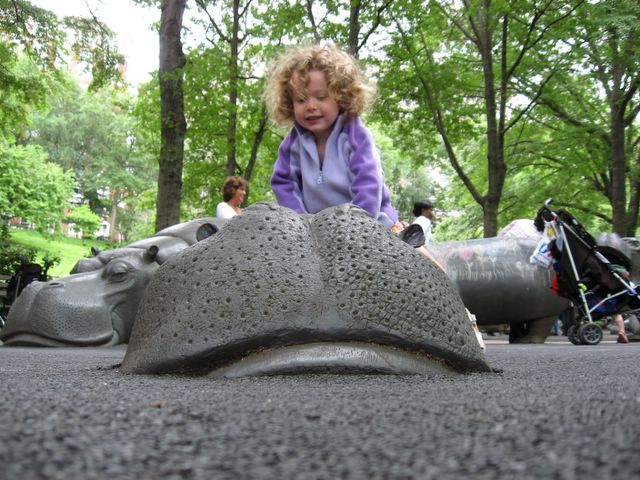
A hippo nose is sure intimidating up close! Posted by Picasa

The Nature of Blogging

At Mike's prompting, I read Tim Challies' post on The Nature of Blogging, which is a helpful pondering on this unique mode of communication. He suggests that blogging is a middle ground between a book, which carries a certain weight of having been carefully considered and edited, and a personal conversation, in which there is an active relationship. I think he has modeled well speaking only what is helpful for building others up.

In addition to what was mentioned there, I think blogging offers some other unique opportunities:

  • to pursue a thread or line of serious thought with others, not bound by a particular time or place.
  • to be critiqued and held accountable for something not just said, but written.
  • to learn from a diverse group of people in conversation.
  • to gain wisdom in community, as we venture statements, listen to one another, and refine our understandings in order to act.
  • to share joys with others in a way that is not confined to the two persons being present at the same time.
I consider all of these rich privileges, and relish the opportunity to express, to listen, and to learn. (So feel free to comment!)

I want you to go out

Elisabeth is at a stage at which she realizes that I won't permit her to disobey. She hasn't yet realized that obedience extends to those times when parents aren't present. For example, I don't let her chew on her blanket. When she puts it in her mouth, I tell her to take it out. She knows that she has to comply, so recently she has taken to obeying quickly and then saying,

"Daddy, I want you to go out."
The battle is only half-won.

Naptimes

I still haven't figured out a good naptime routine. Elisabeth still needs a nap, but doesn't have a good routine for quieting herself to sleep. Most days at about 1:30, we read a story together, and then she climbs in bed. She knows that she is not allowed to get out of bed, but she is allowed to read board books (so that we don't have crumpled pages) while she is in bed. She can often do this for an hour or two before she's ready to sleep. I would love to find a way to learn to teach her to quiet herself and go to sleep peacefully and quickly so that she gets to sleep earlier, gets the sleep that she needs, and is ready for an earlier bedtime at night.

Suggestions, anyone?

If you don't pray, you aren't a Christian

I was listening this morning to John Piper on Learning to pray in the Spirit and the Word. In it, he made the bold statement,

"If you don't pray, you aren't a Christian."
He went on to explain: Prayer is to the spiritual life what breathing is to the physical. If you don't do it, you die.

Monday, June 12, 2006


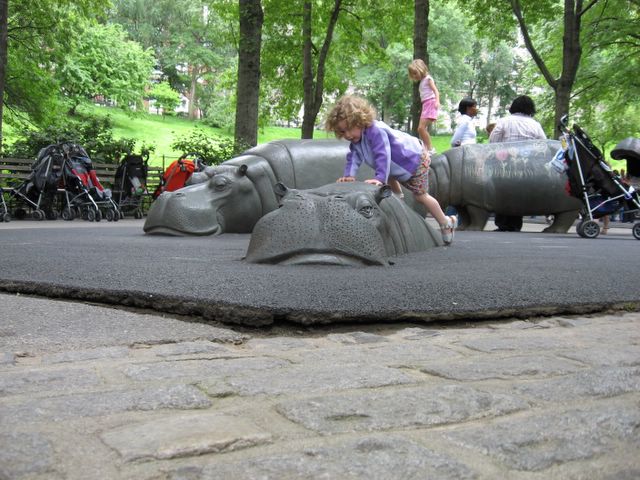
I only let Elisabeth climb on pretend Hippos. Posted by Picasa

Talking to Yourself

'In his excellent book Spiritual Depression, Martyn Lloyd-Jones asked, "Have you realized that most of your unhappiness in life is due to the fact that you are listening to yourself instead of talking to yourself?" That's profound, and it's true.' (Mahaney, C.J. "Humility: True Greatness." Sisters, Oregon: Multnomah. 2005. p69)
What Lloyd-Jones is talking about is preaching to ourselves, in the sense of telling ourselves the truth as God has revealed it when we don't feel it and are tempted not to believe it. I find constantly, especially through the Psalms, that I need the Holy Spirit to speak truth to my heart. As I meditate on the Scriptures (talking to myself, preaching to myself, reminding myself of true, yet invisible, reality) the Holy Spirit can break through my darkness with glorious light.

I want starfall!

This morning, just before 5am, we heard these words distinctly coming over the monitor from Elisabeth's room:

"I want starfall!"
I guess she's even dreaming about starfall now! I'm encouraged that she likes it so much. Elisabeth is now consistent on letter/letter name recognition for all her letters. She connects the appropriate letter sound with most letters, either oral or written, and even walks around the house chanting the short vowel names, the silent e rule, and the double e rule! Elisabeth loves making words, and it has been great for helping her to listen for the onset sound.

If you have a toddler, I highly recommend starfall - although you'll be hearing it in your sleep.

Sunday, June 11, 2006


Elisabeth is captivated by the polar bears. Posted by Picasa

Friday, June 09, 2006


Look at this flower, Daddy! Posted by Picasa

Phone recommendations?

A few months ago, I dropped my phone in a sink full of water. I replaced the battery, and after it had dried out, it worked again . . . on my end. I can hear folks loud and clear, the trouble is that they can't hear me. I think my phone's little dip hurt the microphone, not to mention reception powers.

So I'm looking to replace. Does anyone have recommendations of Sprint phones that are fantastic or ones to avoid?

The glory of Christ


Yesterday I received a wonderful gift (a book) in the mail from a great friend. It was inscribed with these words:

There is no more beautiful, worthy, or wonderful thing or person than Jesus Christ. I hope that this book helps you to more fully treasure Him for who He is, what He has done and what He has promised He will do.
The book is John Owen's The Glory of Christ which Sinclair Ferguson describes in this way:
To read any of his works is to be introduced to a mind that soared to the heights of Trinitarian theology, penetrated into the depths of human sinfulness and grasped the wonders of God's grace. He was a pastoral theologian par exellence. To read his works is inevitably to come to the conclusion that much contemporary Christian literature seems like wood, hay and stubble by comparison with the gold, silver and precious stones with which this master builder worked.
I've already glimpsed a bit of Owen's workmanship (as I've posted over the past several days), and am eager to get a see again the glory of Christ through Owen's writing.

Thursday, June 08, 2006


This is among a series of fantastic photos over a year ago. I came across it as I'm culling our old albums . . . and had to share it. Posted by Picasa


Can you see my tonsils? Posted by Picasa

Score: 1 for toddler, 0 for Mommy

"Bye, Ellie!" the mother said as she walked toward the gate of the playground. The toddler sat in the sandbox and waved, "Bye, Mommy!" (That was not the response Mommy was looking for. She was trying to scare the toddler into getting out of the sandbox and following her home.

Score: 1 for toddler, 0 for Mommy.

I see this almost on a daily basis as Elisabeth and I frequent the playgrounds near our home. What I don't think the parents and nannies realize is that they are undermining their own authority. They are saying that they will do something that they won't do, and the children will learn that their threats (and therefore all their words) are empty.

Good parenting must follow this rule: Speak once (and once only) and require obedience.

You have fruit salad!

In preparation to shower, I brought my clothes to the bathroom and set them on the toilet seat. Elisabeth picked up my underwear, pointed to the tag and said,

"You have fruit salad!"

Wednesday, June 07, 2006

No room for sin

"Fill your affections with the cross of Christ," wrote John Owen, "that there may be no room for sin." (Mahaney, C.J. "Humility: True Greatness." Sisters, Oregon: Multnomah. 2005. p66 )
If Owen is right (and he is), then we must learn to fill our affections with the cross - and glory - of Christ. How? Primarily by meditation, by setting our eyes and our hearts on the humiliation, and glory, of our King.

I don't want to be pretty

Yesterday I attempted to put Elisabeth's hair in pigtails. Although I've improved since Elisabeth's hair has become long enough to put in pigtails, I'm still not nearly as good as Mom at a straight part, gathering all the hair, and doing it painlessly. When I told Elisabeth that I was going to put the hairbands in, she quickly replied,

"I don't want to be pretty!"
I hadn't even said anything about how her hair would look! She has simply concluded: pretty is not worth pain. I can understand that.

Tuesday, June 06, 2006

John Owen on Humility

John Owen writes, "There are two things that are suited to humble the souls of men. . . . A due consideration of God, and then of ourselves. Of God, in his greatness, glory, holiness, power, majesty and authority; of ourselves, in our mean, abject and sinful condition." (Mahaney, C.J. "Humility: True Greatness." Sisters, Oregon: Multnomah. 2005. p92)
If these are the two things suited to promoting humility (and I think nails it exactly, and in the right order), it is little wonder we are so arrogant. How often do we give God due consideration, particularly in His greatness, glory, holiness, power, majesty and authority? Do not most preachers and authors prefer to present Him as friend and helper? Who is willing to confront us with our truly mean, abject and sinful condition which separates us from fellowship with God, and from which we cannot extricate ourselves?

God give us, and make us, such preachers, authors . . . and friends.

A true view of sin

Bonhoeffer's insight into the nature of sin is tremendously helpful in giving us the nerve to rebuke when necessary:

Nothing can be more cruel than the tenderness that consigns another to his sin. Nothing can be more compassionate than the severe rebuke that calls his brother back from the path of sin. (Bonhoeffer, Dietrich. Life Together. San Francisco, CA: Harper Collins. 1954 p107)

Monday, June 05, 2006


Elisabeth, as you can see, is captivated by horizontal lines. Posted by Picasa

Receiving Rebuke

The more we learn to allow others to speak the Word to us, to accept humbly and gratefully even severe reproaches and admonitions, the more free and objective will we be in speaking ourselves. The person whose touchiness and vanity make him spurn a brother's earnest censure cannot speak the truth in humility to others; he is afraid of being rebuffed and of feeling that he has been aggrieved. The touchy person will always become a flatterer and very soon he will come to despise and slander his brother. But the humble person will stick both to truth and to love. He will stick to the Word of God and let it lead him to his brother. Because he seeks nothingfor himself and has no fears for himself, he can help his brother through the Word. (Bonhoeffer, Dietrich. "Life Together." San Francisco, CA: Harper Collins. 1954 p106-107)
This morning I was rebuked by someone I didn't know (and so I don't know if she was a sister or not), and recalled these words of Bonhoeffer. I need reminders like this of how to receive rebuke - both for myself, and to teach Elisabeth how to receive rebuke.

Sunday, June 04, 2006

Home Grown World Christians

I often think about how to cultivate a global Christian perspective, and how to impart it to Elisabeth. My friend Lauren recommended this, which I thought was great. I need people like that (both Lauren, and Noel Piper, the author), who prod me to think about how we are raising Elisabeth to see God's world through His eyes.

Life Together: A Book Review


Dietrich Bonhoeffer speaks with authority on the dynamics of life together in Christ. His book offers both the theological framework for understanding Christian community (which I found riveting, clear, and immensely helpful) and practical advice for living the life together. His practical counsel flows from his own experience of Christian community, and is therefore valid - and limited. At times his counsel sounds like pontification; at others it has the ring of truth that transcends culture and circumstances. If one listens for that ring of truth there is much to be gleaned.

Bonhoeffer unfolds the interrelationship of community and aloneness. "Let him who cannot be alone beware of community. . . . Let him who is not in community beware of being alone." He constantly upholds Christ as the only source of true relationship with others, and the Word of Christ as that which defines and integrates our corporate life.

I heartily recommend Life Together for growing together in Christ.


Elisabeth enjoyed watercolors yesterday, with this colorful result. Posted by Picasa

Saturday, June 03, 2006

Seeking book recommendations

Recently we had someone very generously give us a check "to be used only for books." So I am looking for recommendations on the best Christian children's literature, particularly works that expand a child's worldview (e.g. Windows on the World) or that are great literature (e.g. Tales of the Restoration). So what do you recommend?

The solemn joy of parenting

"And His mercy is for those who fear Him
from generation to generation" (Luke 1:50)
These words bid all parents to love their children by teaching them to fear the Lord. His mercy is for those who fear Him! If we want our children to taste the joys and freedom of God's mercy, we must teach them to fear Him - first by modeling, and also with words. This is our solemn responsiblity, and our great and overflowing joy.


Another one from the new camera Posted by Picasa

Friday, June 02, 2006

Hello?

Does anyone use Hello? It looks like it has clever interface with Blogger, and has the beauty of being able to share with a discrete list securely. I think I'll try it unless someone someone can counsel me otherwise.

Is it my turn now?

To turn the hearts of the fathers

Even before the birth of John the Baptist, his role was revealed:

And he will turn many of the children of Israel to the Lord their God, and he will go before him in the spirit and power of Elijah, to turn the hearts of the fathers to the children, and the disobedient to the wisdom of the just, to make ready for the Lord a people prepared. (Luke 1:16-17)
John is to cause others to turn, to repent. It is not surprising that he will turn the children of Israel to the Lord, nor that he will draw the disobedient to turn to wisdom. A prophet turns people from idols to the Lord, from rebellion to wisdom. Yet sandwiched in this turning to make ready a people prepared for the Lord is this phrase: to turn the hearts of the fathers to the children.

Sin has broken the father-child relationship, mirroring the destruction of our relationship with our Father who made us. In God's scheme of redemption, the father-child relationship must be restored. Luke could have quoted all of Malachi 4:6, the closing words of the Old Testament:
"And he will turn the hearts of fathers to their children and the hearts of children to their fathers, lest I come and strike the land with a decree of utter destruction.”
Yet he does not mention the work of turning the hearts of children to their fathers, but only of fathers to their children. Turning the hearts of fathers to their children is at the very heart of repentance unto salvation. God give us grace to so live, to turn the hearts of fathers to their children - and to strengthen them in that repentance - to make ready for the Lord a people prepared!

A new camera


After over three weeks of waiting for Best Buy to repair my camera, they finally said yesterday that they can't get the part in a timely manner and replaced the camera instead. Since they didn't have my old Canon a610, I moved up to the a540. So look for some new pictures soon!

A tear-free bath

Yesterday was a milestone. For the first time in a very long while Elisabeth had her hair washed without copious tears. We picked a foam rubber visor made by Sassy (I looked all over the web for a picture to put up here, but couldn't find one) at Babies'R'Us. They kept the water out of her eyes, and her hair was properly rinsed for the first time in ages. And there was great rejoicing!

I don't want to use that one!

Yesterday we were in the park enjoying the flowers. Elisabeth told me that she needed to use the potty, so we found a public restroom. (We have already had the conversation that we only use the men's room, since daddies can't go in the ladies' room.) I pulled the stroller in, and parked it outside a stall, in front of a urinal (so that we could go into the stall). Elisabeth pointed to the urinal and quickly said,

"I don't want to use that one!"

Good choice, sweetheart.

Thursday, June 01, 2006

From the archives

Since the camera still isn't back, here's a picture from last month at the fountain.