Showing posts with label Book Reviews. Show all posts

Monday, April 07, 2008

The Call of Stories

The Call of Stories is a powerful call to stories and through stories. Robert Coles, a pediatric psychiatrist and prolific author, writes brilliantly on the role that stories play in shaping character. He writes from the experience of teaching literature at Harvard to undergraduates, and in almost every one of Harvard's graduate schools. Time and again he recounts how stories affected his students in ways that challenged and changed them - in a way only stories can do.

Although Coles isn't dealing here with children's literature, the implications are clear. We engage in stories in a unique way, identifying with the characters, feeling outrage at wrong, and even coming to see our own hypocrisy. Stories, both oral and written, can and should play a significant role in the education, and moral and spiritual formation of children. To neglect great stories is to dispense with the most powerful and vital tool of education.

For parents interested in children's literature, this is an excellent book. I'll warn you in advance that for all its merits, the conclusion is decidedly lacking. Coles clearly perceives the powerful role that literature plays, but doesn't have a larger framework of purpose within which these forces make sense. Even with first rate insight, he comes up lacking because he doesn't see the ultimate purpose behind moral formation. However, for those who see that purpose, this book will be immensely helpful.

Wednesday, February 20, 2008

Foolishness to the Greeks

It is a rare thing for me to reread a book. I often return to a good book and reread passages from it, but I cannot remember when I last finished a book and picked it up to start reading it again from the beginning.

However, when I finished reading Foolishness to the Greeks, I returned to the beginning and started rereading. On my first encounter with Newbigin, I had to reread just to understand what he was saying because his paradigm was so different from mine. (I daresay my outlook was so syncretistic that I couldn't understand another Christian who didn't share my syncretisms.) Now that I've undergone a sort of Newbiginian revolution, I am reading voraciously to understand. In Foolishness to the Greeks, he explores this question in depth:

"What would it mean if, instead of trying to explain the gospel in terms of our modern scientific culture, we tried to explain our culture in terms of the gospel?" (p41)
In doing precisely that, he has completely upended my world view. My understanding of education, commerce, and the church have undergone a seismic shift.
"The former statement (i.e., that the tomb was empty) can be accepted as a fact only if the whole plausibility structure of contemporary Western culture is called into question." (p62)
In other words, "it is idle to suppose that any kind of peaceful coexistence is possible between these two ways of understanding history" (61). The truth of the good news of Jesus says that the modern Western vision (its plausibility structure) is not only inadequate; it is false because it claims to see truth. It is not merely an invitation to adopt a belief system. It is a call to conversion "in which the most real of all realities is the living God whose character is 'rendered' for us in the pages of Scripture" (64).

If you haven't recommend Newbigin, I highly recommend starting with Foolishness to the Greeks.

Friday, January 04, 2008

The Family Worship Book

Before reading Family Driven Faith, I hadn't thought much about the difference between family devotions and family worship. Voddie Baucham primed the pump so that when someone offered to buy me a book for Christmas, I knew precisely what kind of book I wanted. Through some helpful reviews on Amazon, I found The Family Worship Book, which I am pleased to commend just as strongly as they did.

For those who are unconvinced of the importance not merely of Biblical instruction in the home, but of regular family worship, this book provides a helpful and brief overview of why Christians in generations past have considered it indispensable. The author, Terry Johnson, is quite forthright in tracing his heritage to the Westminster Confessions and Catechisms - and provides explanation for why he leans on them so heavily (which you will probably see popping up in my quotables in the days to come). I think his argument is compelling for those who are already sensitive to the issues (as I was), and I think would be very challenging to someone who has not considered the responsibilities of family worship.

Many books are good at casting vision without providing any practical resources for doing so, and I am pleased to say that such is not the case with The Family Worship Book. The author is diligent to outline what he sees as the important elements of family worship, and then offers a sample liturgy for how to conduct family worship. In addition, he includes:

  • two catechisms, sans proof texts (including the Westminster Shorter Catechism)
  • a great list of hymns and psalms (sadly without scores, although he recommends several CDs that have numerous of the psalms and hymns on them)
  • a list of 50 important passages for memorization (including great OT texts)
  • a family reading record that uses a harmonization approach for reading with young children
  • a great selection of Scriptures for call to worship, and confession (reprinted, so you don't have to look them all up)
  • the Apostles', Nicene, and Westminster creeds
  • and a recommended pattern for introducing (and reviewing) psalms/hymns, memorization passages, and the creeds.
With a few bookmarks, this is a rich resource for beginning to practice family worship rather than just talking about its importance. I haven't yet found a better book to call and equip parents to lead their families in fellowship with Christ.

Monday, December 03, 2007

Family Driven Faith

"You are not likely to see any general reformation, till you procure family reformation. Some little religion there may be here and there; but while it is confined to single persons, and is not promoted in families, it will not prosper, nor promise future increase" (Richard Baxter quoted in Family Driven Faith p213)
Baxter's wise observation is the foundation of this book. Clearly Voddie Baucham has internalized the necessity of "family reformation," the turning of the family together to Christ. Furthermore, he does not write without experience. Having grown up in a single parent home, and then raising three children in a faithful marriage, Baucham is not naive. He knows the challenges, and what is at stake.

I highly recommend his section on family worship (pages 139-148) which makes a strong case for the importance of family worship, and offers practical encouragement for how to establish the practice in a home that doesn't have a history of family worship. I was convicted afresh of my own need to move from Bible reading and prayer routine into family worship that incorporates reading, prayer, dialogue (through catechism) and worship. It became very apparent to me that the centrality of worship in family life can have an entirely different tone than even faithful reading and prayer may produce. Now I need to put it into practice!

I also recommend the final chapter, A Radical Departure from the Norm, not as a prescription for how to change, but as a helpful glimpse into family-integrated church. He identifies the following distinctives of family-integrated church:
  1. Families worship together (rather than sending kids out during the service)
  2. No systematic segregation (worship, discipleship and evangelism are age diverse)
  3. Evangelism and discipleship in and through homes (through daily family worship)
  4. Emphasis on education as a key component of discipleship (i.e. private or home schooling)
For me, it was an eye-opening glimpse into another possible way of worship, discipleship and evangelism.

Unfortunately, I can't recommend this book without qualification. The author is very opinionated, and makes statements that go much farther than I would go. So for those who are easily offended, I wouldn't recommend this book. If you can sift well (and aren't easily riled), this book is a helpful one for encouraging parents lead their children into the knowledge of God.

Saturday, November 17, 2007

Overcoming Sin and Temptation

When I arrived home from my travels last weekend, I told my wife, "I finished Overcoming Sin and Temptation!" (It is the book that I completed, and not the struggle!)

I first read John Owen at full length in The Glory of Christ, and found the experience to be both challenging and richly rewarding. In all honesty, I would say that Overcoming Sin and Temptation is just as rewarding as The Glory of Christ, but (at least for me) more challenging reading.

So why tackle 407 pages of small print, precise language and archaic syntax? Owen has such a clear view of the glory of Christ, the nature of the Gospel, and how to wage war on indwelling sin that on almost every page I was struck with fresh insight. On the very subject Owen notes:

"Growing in notions of truth without answerable practice is another thing that indwelling sin makes use of to bring the souls of believers unto a decay. . . . By this means, from humble, close walking, have many withered into an empty, barren, talking profession. . . . And generally this is so when men content themselves, as was said, with the notions of truth, without laboring after an experience of the power of them in their hearts, and the bringing forth the fruit of them in their lives, on which a decay must needs ensue" (p386).
He did not intend people to read his writings just to get insight; in fact he saw it as potentially destructive! Rather he wrote a theological treatise on how to kill that which can take what is good and make it deadly to us. There are few authors that I have found that so successful navigate the course to faithful doctrine and faithful practice. It would seem that this very reality is the reason that Owen wrote: there was much true profession without answerable practice, and much falling away, even in the midst of true doctrine:
"This is indwelling sin. So wonderfully powerful, so effectually poisonous it is, that it can bring leanness on the souls of men in the midst of all precious means of growth and flourishing. It may well make us tremble, to see men living under and in the means of the gospel, preaching, praying, administration of the sacraments, and yet grow colder every day than others in zeal for God, more selfish and worldly, even habitually to decline as to the degrees of holiness which they had attained to." (p370)
Those are sober words; and yet Owen is convinced that through the Gospel we are given everything we need for life and godliness, which he presses on believers with tremendous force.

It is this reality, the insidious power of sin and the glorious power of the Gospel, that makes such difficult reading worthwhile. After reading Owen, I see how trifling vast swaths of contemporary Christian literature (and my own writing!) are. We simply don't have the acquaintance with indwelling sin, or the Gospel, that Owen had. So, from three centuries ago, he offers timely warnings, and powerful counsel.

I can't escape from commenting on how I read Owen as a parent. I no longer read simply for myself; all of my reading is for my family as well as myself. I have found no one better (yes, I think he is even more helpful than Jonathan Edwards) for treating the subtleties of our hearts, and applying the gospel remedies. Dozens of times in the course of reading this book (which has been at least six months), I have been corrected in my parenting, though Owen rarely makes direct references to the responsibilities of parents. In fact, I think someone should apply Owen's theology (which is simply careful, practical, Biblical systematics) to child-rearing. Any takers?

Parenting in the Pew

Our Sunday school class has been reading Parenting in the Pew by Robbie Castleman, as a discussion-starter for parents.

In this sphere, I think it succeeds. Castleman raises some of the major issues of teaching children to worship, and offers some of her own experiences for insight into how to do it. I must admit that it made me much more conscious of how I was leading Elisabeth into worship last week in our Sunday service - and exposed a number of my bad habits. This book is great for getting parents (and others) thinking actively about how we teach our children to worship Christ.

I wouldn't, however, commend this book as the How to of teaching children to worship. Many of her examples are historically and culturally bound, and don't translate perfectly to other circumstances. I don't think that these qualities are reasons not to recommend the book, just words of fair warning for what you will find.

If anyone has recommendations of books that provide helpful recommendations of how to, please share!

Honey for a Child's Heart

Where The Read Aloud Handbook fell short, Honey for a Child's Heart excels. It commends the value of literature for capturing the imagination and shaping character far more than the Handbook. Whereas Jim Trelease sees reading (aloud and silently) as the crux of education, Gladys Hunt presents them as the crucible of character formation.

Like the Handbook, Honey is divided into two parts: expository text, and literature recommendations. The entire book is shaped by this conviction:

"You cannot bully people into appreciating what is true and good and beautiful." (p95)
The necessary corollary is that parents have the responsibility for winsomely presenting what is good, true and beautiful to their children. Hunt contends that literature is one great vehicle of achieving this end, and I think she succeeds in her case. I found myself remembering from my childhood many of the books she referenced, and I found myself longing to explore others that I missed out on.

I found her writing so compelling and inspiring that it made me want to homeschool not from any dissatisfaction with other means of education, but just because I want to have the privilege of soaking Elisabeth, and any other children God gives us, in great literature.

I'll leave you with her presuppositions (which I share):
"Underlying all of this discussion is my thesis that parents who read widely together with their children are going to be those who most influence their children, who have the largest worldview, who have an uncommon delight in what is good and true and beautiful - and an uncommon commitment to it. Sharing and feeling and talking together will come naturally. Books shared with each other provide that kind of climate." (p99)

Friday, November 16, 2007

The Read Aloud Handbook

Last weekend I had the privilege of traveling for business and pleasure. I took every advantage of the time in on the bus, in the airport, and on the plane to devour books that had been collecting dust for the past month or two. I was able to finish off several that I have been working on, and want to commend some of them to you.

The Read Aloud Handbook makes the case that parents reading aloud to children is the linchpin of successful education. Jim Trelease, very well acquainted with school policy and politics, and research on reading development, contends that reading to and with children throughout their years in the home fosters a love for reading, facility with ideas, critical thinking skills and open horizons.

For those who aren't convinced that parental reading plays a key role in their children's lives, I commend this book. For those who are already convinced, I commend the second half of the book, which is a treasury of recommendations for reading aloud. It will save you wading through many pieces of poor literature in an attempt to find good books for your kids.

In addition to his case for reading aloud, Trelease also offers creative ideas for establishing patterns of sustained silent reading, how to use the television to enhance literacy, and how to use audio books to enable children to enjoy literature that would prove difficult reading. His tips are practical and helpful, and I commend this book to parents and teachers alike.

Saturday, November 03, 2007

Feed your kids

As a teacher, I consistently told parents, "The most important thing that you can do for your child's education is to read with your child." I still think that is true. However, I now see that it is inadequate. It is like saying, "Feed your kids," without giving any nutritional advice. So one parent will take the children to McDonald's for every meal, while another will provide a healthy variety of foods. My exhortation to "feed your kids" is not helpful in the health of those children, because I didn't say anything meaningful.

A more helpful admonition than "feed your kids" is "feed your children a balanced diet of fruits, vegetables, protein, and fat in moderation." The parent who heeds my advice will be truly helping his or her children. In just the same way, rather than saying "read with your child," it is far better to say, "Read books with your children that communicate truth, goodness and beauty, that inspire your children to virtue."

However, just as a trip to the vegetable aisle might be daunting to the parent who is accustomed to exclusively processed food, so will a trip to the children's section of the library be frightening to the parent who is more comfortable in front of the television. For that reason, I think the good teacher or friend must go farther than commending the reading of great literature to provide examples of that literature so that the novice can learn to identify great literature by immersion in it.

In Honey for a Child's Heart, Gladys Hunt does precisely that: encouraging parents to take up and read great books with their children, describing the characteristics of such literature, and offering lists of such literature for each age of a child's life. She is a much better teacher than I, and I highly commend her book!

Friday, October 26, 2007

Honey for a Child's Heart

We just received a great gift in the mail: Honey for a Child's Heart. (Thanks, Sarah!)

I make it my practice to ask the best parents I know for good book lists, since when I go to the library I usually leave disappointed unless I have gone with a list of recommended titles. So I recently asked friends from our church (the parents of four well home-schooled children) for a book list, and they recommended Honey for a Child's Heart for its lists, and for its approach to literature.

I'm ready for my first trip to the library with book in hand!

Wednesday, October 03, 2007

The Life of David Brainerd

Although I don't read much anymore (although I wish I did), being a full-time parent has afforded lots of time for listening. One of the best books I have listened to (repeatedly) is The Life of David Brainerd by Jonathan Edwards. It is Edwards' compilation of Brainerd's diary, which is a brutally honest testimony of his own spiritual life, and his mission to the native Americans. John Piper has a great catalog of Christians who have treasured this book and explains why:
Why has this life had such an impact? . . . .

The answer for me is that Brainerd's life is a vivid, powerful testimony to the truth that God can and does use weak, sick, discouraged, beat-down, lonely, struggling saints, who cry to him day and night, to accomplish amazing things for his glory. (source)

Why mention it here? This month it is available for free! So if you like to listen to books, this is one not to miss.

Wednesday, August 08, 2007

The Roots of Endurance

When I as growing up, some of the most memorable books my parents read to me were missionary biographies. I remember some of them just as clearly as the great fiction works like the Chronicles of Narnia. Those memories convince me that I want to share the same sorts of treasures with our children.

The Roots of Endurance is a great example of one of the books that I want to read to Elisabeth when she is older (while I find more age appropriate literature until then). Not only does John Piper survey the lives of John Newton, Charles Simeon and William Wilberforce in a way that can capture the imagination of readers, he also interprets their lives in terms of what enabled them to endure through truly difficult circumstances. What could be better for children (or their parents!) than to read accounts of Christians who have found Christ faithful unto death - and learn how to endure in faith as they did? (This book is part of a series of mini-biographies that I highly recommend. They can also be viewed online for free, or you can listen to Piper presenting them at the Desiring God conferences.)

I'm a slow reader (hence the City of God took me over six months), but The Roots of Endurance took me only 4 days. It is a great way to meet the author of Amazing Grace, the man who fought for and finally achieved the abolition of slavery in Great Britain, and one whose influence reached far beyond Trinity Church, Cambridge, where he persevered for fifty-four years.

This is a great place for parents to start with missionary biographies!

Monday, July 02, 2007

The City of God

At long last, and with the help of two faithful compatriots, I have finally finished reading Augustine's City of God.

In the introduction, Thomas Merton recommends that "no one who is not a specialist, with a good background of history or or theology or of philosophy, ought to attempt to read the City for the first time, beginning at page one. The living heart of the City is found in Book Nineteen." Having read the whole thing, I can understand his recommendation (and can attest that some sections are overly thorough and require real stamina), and yet I believe the whole thing is worth reading.

Augustine is writing to answer those who contend that Rome fell because of Christianity, and to show that the people whom God calls (whom he calls the 'city of God') do in fact seek the welfare of their earthly cities, including Rome - but not in a way that is limited to these cities' temporal welfare.

So he traces this 'city' from Adam and Eve through the Scriptures to the present (early fifth century AD), and looks forward to their final end: "the end without end" where they forever see the face of God. I would compare it to a tour around the edge of that great City like John takes in the book of Revelation. Walking around it, you are amazed by its immensity, and when, on occasion, you get a clear view through a window into the City, it takes your breath away. There are many times in reading the City of God that one is simply gazing at enormous blocks of stone. Yet there are also brilliantly clear windows, some separated by great distances of hard stone, and others lined one after another. Book nineteen is a "window section" into the City of God. For those who haven't read Augustine, I would recommend looking through the windows of Book 19, and then going back to Book 1, with some friends, and taking the entire tour. There are many other windows in the previous books that provide glimpses of the City that simply can't be seen from Book 19 to the end.

As Thomas Merton says in his introduction to the City of God, "The City of God is an exposition of dogma that was not only written but lived," which is precisely what makes it such a worthwhile read. Thus it is best read, and lived, in community.

I can't escape reviewing the City without noting that perhaps the person who composed the blurb on the back of the book took Merton's advice and didn't read the whole thing. The blurb reads:

The City of God provides an insightful interpretation of the development of modern Western society and the origin of most Western thought. Contrasting earthly and heavenly cities - representing the omnipresent struggle between good and evil - August explores human history in its relation to all eternity.
Any would-be readers should be informed that Augustine is emphatically not offering 'an insightful interpretation of modern Western society'. He is setting that tiny piece of human culture within the grand panorama of Christ's redemption from the very first human being to 'the end without end.' Furthermore, one of the cornerstones of the City is that the struggle between good and evil is not omnipresent. Rather evil has a finite historical origin in created beings with good natures turning away from the end for which they were created; and evil will have an end, when all things are put under Christ's feet, and He is all in all.

That is the end to which Augustine writes, and to which I commend this book.

Monday, March 05, 2007

The Best Recipe = the best hummus

Yesterday I made hummus by following the recipe from The New Best Recipe for the first time. Once again I was not disappointed. It was far better than any hummus I have made before. (I have yet to try anything from this book that does not turn out to be the best version of it I have made or had).

So I realized the The New Best Recipe is worthy of a book review. If you don't own a cookbook, this is the one to get. If you have a dozen, this one is better. You can get a smattering of the recipes from the folks who publish it at America's Test Kitchen right here.

Sunday, December 31, 2006

Humility

At long last, I have finished Andrew Murray's little book, Humility. It is well worth reading slowly and re-reading.

Reading Andrew Murray is unlike reading most contemporary authors. In writing, he assumes that Christianity that is not experiential is not real Christianity. So he is after truth, and deep personal experience of that reality.

That is the context in which he casts humility: It is our being nothing before the God who is everything. It is the experience of Him being all in all.

Whereas many authors take our fallen condition as the ground for humility (i.e. God is holy, and we are sinful), Murray takes a step further back. He argues persuasively that humility is part of the creation order. In God's design before the Fall, we were to be utterly dependent on Him:

But as God is the ever-living, ever-present, ever-acting One, who upholds all things by teh word of His power, and in whom all things exist, the relation of the creature to God could only be one of unceasing, absolute, universal dependence. . . . Humility, the place of entire dependence on God, is, from the very nature of things, the first duty and highest virtue of the creature. In fact, it is the root of every virtue. . . . Hence it follows that nothing can be our redemption but the restoration of the lost humility, the original and only true relation of the creature to its God. And so Jesus came to bring humility back to earth, to make us partakers of it, and by it to save us (12, 13).

What is this humility?
It is not something which we bring to God, or which He bestows; it is simply the entire nothingness which comes when we see how truly God is ALL, and in which we make way for God to be ALL (14).

Murray clarifies what he means:
If this leads us to utter despair of ever conquering or casting [pride] out, it will lead us all the sooner to that supernatural power in which alone our deliverance is to be found - the redemption of the Lamb of God (19).

With rich metaphors, Murray communicates the ways of God:
Just as water ever seeks and fills the lowest place, so the moment God finds the creature abased and empty will His glory and power flow in to exalt and to bless (36).

The humility that Murray puts forth is not that of the hermit:
Our humility before God has no value except as it prepares us to reveal the humility of Jesus to our fellow men (49).

Though he sees humility as a creation order, Murray speaks insightfully to humility in sinfulness:
It is not sin, but grace that will make me indeed know myself a sinner, and make the sinner's place of deepest self-abasement the place I never leave. . . . It is the revelation of God, not only by the law condemning sin but by His grace delivering from it, that will make us humble. . . . Not to be occupied with your sin, but to be occupied with God, brings deliverance from self (68, 69, 70).

Amidst all the wisdom that Murray offers, there was one insight that has more shaken me than any other: Grace not only can come at the cost of my pride; it comes only at that price. The only way to seek grace is to seek humility, that God may be ALL; for God opposes the proud but gives grace to the humble.

I have many times prayed for God to draw me to Himself in ways that didn't humble me. Now I am beginning to see the folly of those requests, and why He wisely gives grace only to the humble.

Saturday, December 30, 2006

The Glory of Christ

John Piper first introduced me to John Owen, and I saw that there was a tremendous depth to him. However, I consistently heard people say that he was difficult to read, so I didn't tackle an entire Owen book until my friend Dylan sent me The Glory of Christ.

For those who are intimidated, be assured that the riches far outweigh the difficulty of reading, which is not really that bad. Once you've read a chapter or two, you get used to his language, and many of the archaic words are defined in the margin.

The entire book is an explication of John 17:24, "Father, I desire that they also whom You gave me may be with me where I am, that they may behold my glory which You have given me."

No man shall ever behold the glory of Christ by sight hereafter, who does not in some measure behold it by faith here in the world. Grace is a ncessary preparation for glory, and faith for sight. Where the subject (the soul) is not previously seasoned with grace and faith, it is not capable of glory or vision (45).
Owen develops this claim. Seeing the glory of Christ by faith is our salvation in this world, and is preparation for being where He is and seeing His glory. With powerful clarity, Owen makes the case that seeing the glory of Christ is the only way to die well:
And this is the advantage we may have in [gazing on the glory of Christ] . . . with respect to death itself: it is the assiduous contemplation of the glory of Christ which will carry us cheerfully and comfortably into it, and through it (31).
I have never come across one who so clearly and succintly teaches believers how to prepare for death. Yet he is not speaking merely of mystical experience:
No man can by faith take a real view of this glory, but virtue will proceed from it in a transforming power to change him 'into the same image' (2 Cor. 3:18) [50].
Since his contention is that our salvation is to see the glory of God in the face of Christ, now as in a glass, and then face to face, he spends a great part of the book setting forth the beauties of Christ in his person and office. One cannot look for a more living and vibrant treatment of the two natures of Christ than Owen provides. It is quite clear that in writing, Owen is doing precisely that to which he is calling his readers: to look long and hard at the beauty of God in Christ.

If you're afraid at this point that Owen is terribly erudite and hopelessly beyond addressing the realities of life in this world, rest easy: Part 2 of the book is devoted to "Application of the Foregoing Meditations Concerning the Glory of Christ." Owen is unparalleled, in my experience, in giving counsel to those who are strangers to Christ, those who are faltering, and all of us who pass through seasons of darkness. I happened to be reading When the Darkness Will Not Lift by John Piper (which I thought was a good book; you can read my review here) while I was finishing up The Glory of Christ. As highly as I regard Piper (which those who know me well can tell you is very highly), Piper's writing is as a school-boy compared to Owen for precision, force and wisdom in going through darkness.

If you would see more of Savior, and love Him more, I heartily recommend to you this book. It will lift your eyes to the Son of God, and fix your gaze there in ways that will transform you into His likeness, and prepare you well to spend all eternity gazing on His beauty.

Note: After publishing this, I ran across two recommendations for Owen on johnowen.org that capture well my feelings:
To read John Owen is to enter a rare world. Whenever I return to one of his works I find myself asking “Why do I spend time reading lesser literature?” —Sinclair B. Ferguson
I owe more to John Owen than to any other theologian, ancient or modern; and I owe more to [The Mortification of Sin] than to anything else he wrote.—J.I. Packer

Friday, December 22, 2006

When the Darkness Will Not Lift

I think it is safe to say that all Christians go through times of darkness; and that is not a safe statement, is is undoubted that each Christian will know another who goes through such a season. So it is of great importance, for the sake of Christ, and of love, to know how to navigate those seasons ourselves, and how to love others through such circumstances.


Here When the Darkness Will Not Lift is of great help. It is filled with much wisdom, and many references to the Puritans, who have tremendous depth in dealing with despairing souls. In fact, after reading this book, I want to go back to the primary sources, all of whom draw heavily on the Scriptures: Richard Baxter, John Newton, John Bunyan, C.H. Spurgeon, and Martyn Lloyd-Jones.


Here are a few glimpses of their wisdom:


'Often set before them the great truths of the gospel which are fittest to comfort them; and read them informing, comforting books; and live in a loving, cheerful manner with them. (Richard Baxter, 69)

"Nothing can wholy satisfy the life of Christ within his followers except the adoption of Christ's purpose toward the world he came to redeem. Fame, pleasure and riches are but husks and ashes in contrast with the boundless and abiding joy of working with God for the fulfillment of his eternal plans. The men who are putting everything into Christ's undertaking are getting out of life its sweetests and most priceless
rewards" (J. Campbell White, 67)

"Fold the arms of thy Faith, and wait in the quietness until light goes up in thy darkness. Fold the arms of thy Faith I say, but not of thy Action: bethink thee of something that thou oughtest to do, and go to do it, if it is but the sweeping of a room, or the preparation of a meal, or a visit to a friend. Heed not thy [hopeless] feelings: Do thy work" (George MacDonald, 46)

Despair of finding any answer in yourself. I pray that you will cease from all efforts to look inside yourself for the rescue you need. I pray that you will do what only desperate people can do, namely, cast yourself on Christ. (Piper, 21)

It is utterly crucial that in our darkness we affirm the wise, strong hand of God to hold us, even when we have no strength to hold him. (Piper, 37)

This is a book full of wise, tender counsel for those in darkness, and for those walking with another who is in darkness.

Wednesday, December 20, 2006

Songs of Heaven

Songs of Heaven is a unique commentary on the book of Revelation. Its thesis is that the book is, as the first verse says, "the revelation of Jesus Christ" and that the throne scenes throughout the book form the framework of the book. The worship that rings around the throne, the songs of heaven, are then a revelation of the One who is seated on the throne. [I make this recommendation now as I am reading through Revelation, and am drawn again and again back to Songs of Heaven as a framework for understanding.]

I have a very personal reason for recommending this out-of-print book. When I was in college, I was in a small group with Robert Coleman for several years, and one of those years, he led us through the hymns of heaven in Revelation in a weekly study. As Lyle Dorsett likes to say, Robert Coleman is one who lives in the throne room. During that year, he ushered a handful of us into the throne room on a weekly basis as he walked through the book. You could see in his eyes, that he had seen the reality. He wasn't just talking about words that he'd read in a book. He was relating that which the Holy Spirit reveals through the book of Revelation.

I highly recommend Songs of Heaven as a preface to, or companion in, reading the book of Revelation.

Friday, December 08, 2006

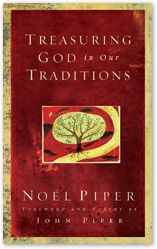
Treasuring God in our Traditions

As Christmas approaches, I think this is a perfect time to reflect on traditions and the role that they play in families.

Before reading Treasuring God in our Traditions I had not thought much about the role that traditions play in shaping the ways that children think about life - and holidays in particular. Noel Piper did an excellent job of setting me straight, and giving some helpful advice toward creatively and deliberately choosing and establishing traditions that set our children's eyes properly on God.
So as we approach Christmas day, I wanted to solicit your input on traditions that have helped you to see and savor Jesus in Christmas.
Comment away!

Sunday, October 29, 2006

Lesslie Newbigin: Missionary Theologian

At long last, I have finished reading Lesslie Newbigin: Missionary Theologian. I would place it easily among top ten books I've ever read. Why? Newbigin offers an outsider view of bringing the good news to western culture in the language of an insider. He lays bare western Christian syncretism more clearly than anyone I've read.

It took me a long time to read this collection of writings from the 1930s to the 1990s. Why? First, Newbigin is a true intellectual (so for me to read someone like this requires the kind of mental work that few authors require). Second, his epistemology is so foreign (i.e. not modern, not postmodern) that one cannot read without being aware of a profound dissonance between his rhetoric, and that of our contemporary context. Finally, Newbigin says so many things that deserve careful thought that I often couldn't read for very long before coming on an idea, argument or claim that consumed my thought life for the next several days.

Since this was essentially my first introduction to Newbigin (apart from a few forrays in college anthropology), I was deeply grateful for this Reader, that comprises writings from the 1930s to the 1990s. It demonstrated the unity, clarity, and cogency of Newbigin's thought over a considerable period, and through diverse historical and cultural situations.

Newbigin's writing is so diverse and rich, that it is hard to do it justice in a review. Here are just a few reasons to read this book:

  1. Newbigin's exposition of the Church as the sign, instrument and foretaste of the Kingdom of God.
  2. Newbigin's exposition and defense of the parish principle: that the church exists for the place in which God has placed it.
  3. Newbigin's penetrating critique of the modern scientific worldview.
  4. Newbigin's twin call to simple, faithful proclamation of the good news and to engage in the complex, challenging work of submitting to Christ as King in public life.
  5. Newbigin's argument that the gospel is public truth and must be proclaimed with that confidence, intent and authority

There are quite literally dozens of other penetrating insights into the church, culture, the gospel, the kingdom and mission, each of which deserves to be enumerated alongside these. But I hope that these will be enough to prod a few people to pick up the book.