Tuesday, October 10, 2006

Dribbling

Yesterday Elisabeth dribbled a soccer ball for the first time. Previously she could kick it, and could even kick it repeatedly, but felt that she had to stop every time in order to kick. Yesterday she was able to keep dribbling on the run!

Humor

On our church retreat, I spent a lot of time laughing. One person had been responsible for preparing the announcements for each session, and he had done a brilliant job of making them funny, enjoyable and memorable. One set was read over a microphone as if by the pilot of a plane while a stewardness in our congregation stood at the front and gave non-verbal directions. For another session, a lawyer read a hilarious disclaimer of responsibility for participating in the weekend. Both had us roaring with laughter.

The laughter got me thinking. It was not irreverent; it was part of our shared life. It made me glad that in the Body of Christ there are times to be serious, and times to be able to laugh at silliness.

The mistaken enterprise of apologetics

There is a long tradition of Christian theology that goes under the name 'apologetics' and that seeks to respond to this question [How can we know that the gospel is true?] and to demonstrate the reasonableness of Christianity. The assumption often underlying titles of this kind is that the gospel can be made acceptable by showing that it does not contravene the requirements of reason as we understand them within the contemporary plausibility structure [=world view]. The heart of my argument is that this is a mistaken policy. The story the church is commissioned to tell, if it is true, is bound to call into question any plausibility structure which is founded on other assumptions. The affirmation that the one by whom and through whom and for whom all creation exists is to be identified with a man who was crucified and rose bodily from the dead cannot possibly be accommodated within any plausibility structure except one of which it is the cornerstone. In any other place in the structure it can only be a stone of stumbling. . . . To look outside of the gospel for a starting point for the demonstration of the reasonableness of the gospel is itself a contradiction of the gospel, for it implies that we look for the logos elsewhere than in Jesus. (Weston, Paul. ed. "Lesslie Newbigin: Missionary Theologian." Grand Rapids, MI: Eerdmans. 2006 p236)

Newbigin has expressed better than I could, what I have long felt. What we announce and embody is foolishness to every world view except the one of which it is the cornerstone.

Being careless

Yesterday I was reminded that I have not been insisting on Elisabeth dressing herself by herself. In the morning I often try to hasten the process so that we can get to wherever we need to go, and in the evening I likewise want to speed the process toward bed - and so I help her instead of requiring her to do it. That doesn't help her at all.

So I have begun to repent. She dressed herself for bed, and this morning will dress herself for the day!

Monday, October 09, 2006

Durable goods

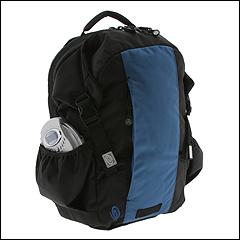
Recently I bought a Timbuk2 Ace on clearance. (Apparently the model has been discontinued.) It has gotten me thinking again about durable goods.

Name What's in a name? I knew I wanted a Timbuk2 because they have a reputation for making durable (near indestructible) bags from the best material. While I agree that many people buy a brand to be seen in it (or with it, or whatever), the name does matter. Timbuk2 is better than many other brands - and will be proved through years of use. Most people in our culture can connect with the reliability of a good name; and it is exactly what we are doing when we proclaim Christ. We are announcing a name that is supremely reliable and trustworthy.


Durable When I buy something like a backpack, I want it to be of a quality that my kids will one day inherit it, and love it, because it was well-made and time-tested. I think it is poor stewardship (not to mention environmentally unsustainable) to buy something like this, knowing that I'll need to replace it in a few years. There is a right and proper satisfaction in a durable good, something that lasts. Yet this is precisely why we ought not to trust in durable goods. Though they may be good, they will fail; they will not endure. That is why Jesus said, "Do not store up for yourselves treasures on earth, where moth and rust destroy, and where thieves break in and steal. For where your treasure is, there your heart will be also." Store up truly durable goods, treasures in heaven [glimpses of the Savior] that cannot be tarnished or taken. But don't buy junk on earth! That is poor stewardship, encourages shoddy work, and ignores the whole principle of choosing that which is better.

Evangelism is not a duty

. . . it is a striking fact that nowhere in the letters of St Paul does the apostle lay upon the Church the duty of evanglism. The gospel is such a tremendous reality that he cannot possibly keep silent about it. 'Woe is me if I do not preach the gospel' (1 Cor 9.16). He seems to take it for granted that the same will be true for his readers. . . . Everyone must hear it. A new creation has begun. One does not have to be summoned to the 'task' of evangelism. If these things are really true, they have to be told. (Weston, Paul. ed. "Lesslie Newbigin: Missionary Theologian." Grand Rapids, MI: Eerdmans. 2006 p231)

This is why we do not need better strategies for evangelism, but true heart experience of the good news that overflows in continual public acclamation and worship. Robert Coleman relates it this way:

The careless way that many of us regard this responsibility [of evangelism] may raise the question of how sincerely we take the message to heart. When Charles Peace, the infamous criminal, was offered by the prison chaplain 'the consolations of religion' on his way to the scaffold, the wretched man turned on him and exclaimed, "Do you believe it? Do you believe it?" Then, with obvious bitterness, he cried: "If I believed that, I would crawl across England on broken glass on my hands and knees to tell men it was true."

Indeed if we really believe that Christ is God and that He died to save the world, then we cannot sit idly by while multitudes perish. Jesus is the only way whereby we can come to the Father. This message must be heard, else there is no hope for mankind. (Coleman, Robert. Songs of Heaven. Old Tappan, NJ: Fleming H. Revell Company. 1980. p65)

The Kitchen Chalkboard

This summer we had the privilege of visiting friends and being in their home. Upon entering their kitchen, I saw a simple small chalkboard designed for writing short messages to others in the household. I expected to see a shopping list, or a list of chores, or the like. What I saw was something else entirely: a quote from Martin Luther.

It caused me to pause and reflect on the ways that we encourage one another. I was refreshed by this word, and by the love it demonstrated. The person who read it had been moved by it, and wanted to share it with the whole household; I praise God for that.

That little chalkboard has helped me to reflect on my quotables. They spring from the same desire, to share glorious truth. Thank you, Matthew, for those words from Luther, and for the example of how beholding beauty leads to pointing others to it.

Sunday, October 08, 2006

Playdate

Elisabeth had such fun with her friends!

The hermeneutic of the church

And yet I confess that I have come to feel that the primary reality of which we have to take acount in seeking for a Christian impact on public life is the Christian congregation. How is it possible that the gospel should be credible, that people should come to believe that the power which has the last word in human affairs is represented by a man hanging on a cross? I am suggesting that the only answer, the only hermeneutic of the gospel, is a congregation of men and women who believe and live by it. I am, of course, not denying the importance of the many activities by which we seek to challenge public life with the gospel - evangelistic campaigns, distribution of Bibles and Christian literature, conferences, and even books such as this one. But I am saying that these are all secondary, and that they have power to accomplish their pupose only as they are rooted in and lead back to a believing community. (Weston, Paul. "Lesslie Newbigin: Missionary Theologian." Grand Rapids, MI: Eerdmans. 2006 p152)

For a demonstration of the truth of Newbigin's statement, see this article in the Dallas Morning News. (HT: Michael Hart)

How do you relate to God as a person?

Recently a wise friend asked me a penetrating question: How do you relate to God as a person? His question was anything but theoretical. Its very nature is practical. How do we, as Christians, relate daily to God as a person?

Jesus will say to some who have prophesied, cast out demons and performed mighty works,

"I never knew you; depart from me, you workers of lawlessness" (Matthew 7:23).
It is of central importance that we learn to relate to God as a person according to His design that we not hear these terrible words.

So how do we grow in knowing God, and not merely knowing about Him?

Multiple Intelligences

I am truly grateful to my graduate education for exposing me to Gardner's Mutliple intelligences. I am particularly thankful as I teach Elisabeth, because it forces me to think of how to help her develop in areas in which I don't naturally excel. Simply being aware of these categories helps me to develop a more well-rounded experience for Elisabeth, as well as providing some interesting variety in our daily routines.

To that end, please share literature, activities, or other suggestions for fun ways to engage kids in each of these areas.

George Mueller's rationale

The three chief reasons for establishing an Orphan-House are: 1. That God may be glorified, should He be pleased to furnish me with the means, in its being seen that it is not a vain thing to trust in Him; and that thus the faith of His children may be strengthened. 2. The spiritual welfare of fatherless and motherless children. 3. Their temporal welfare.

It seemed to me best done, by the establishing of an Orphan-House. It needed to be something which could be seen, even by the natural eye. Now, if I, a poor man, simply by prayer and faith, obtained, without asking any individual, the means for establishing and carrying on an Orphan-House: there would be something which, with the Lord's blessing, might be instrumental in strengthening the faith of the children of God besides being a testimony to the consciences of the unconverted, of the reality of the things of God. This, then, was the primary reason, for establishing the Orphan-House. . . The first and primary object of the work was, (and still is) that God might be magnified by the fact, that the orphans under my care are provided, with all they need, only by prayer and faith, without any one being asked by me or my fellow-laborers, whereby it may be seen, that God is FAITHFUL STILL, and HEARS PRAYER STILL. (Mueller's Strategy for Showing God)

When I heard these, I saw why God saw fit to so consistently answer Mueller's prayers. Mueller lived so that God should be glorified . . . in its being seen that it is not a vain thing to trust in Him. It was this that enabled him to give so much spiritual and physical help to the orphans for whom he cared.

Saturday, October 07, 2006

The refrigerator light


Today Elisabeth discovered that the light in the refrigerator does not always stay on. She opened and closed, opened and closed, watching the light miraculously turn off as the door was almost closed.

Posted by Picasa

2 two year olds at the museum


On a Rock

Elisabeth found a new rock on which to perch. Posted by Picasa

Say, "Please may I have it?"

Elisabeth loves to hand me my towel after I have showered. We have a routine where she plays in her room during my shower, and as soon as she hears the shower stop, she races in to hand my towel into the shower. A few days ago I heard her little voice outside the shower:

Would you like your towel?
"Yes, please," I responded. She returned,
You need to say, "Please may I have it."
She's holding me to my own word!

Newbigin Digest

I think I can accurately say that Lesslie Newbigin is the most seminal thinker I have ever read. I think this is because he was raised in the West, and was therefore educated and encultured in it. He left the West as a missionary to India for over thirty years, and then returned to the United Kingdom late in life as a missionary. Consequently, he has the eyes of an outsider to see Western culture and describe it, but unlike other outsiders who can see it, Newbigin also speaks the language of the West, having been raised in it, and can deconstruct our culture from the inside. These factors alone make for a breathtakingly clear view of modern Western culture. Yet what has made Newbigin's writings revolutionary for me, is his unceasing passion for the unity and mission of the church to achieve their purpose: the glory of Christ.

I've posted many excerpts from Newbigin (and more will follow) but I wanted to include here this Newbigin Digest from my friend Mike, who has been reading through Lesslie Newbigin: Missionary Theologian with me, and discussing it weekly.

Dichotomy 1
Dichotomy 2
Dichotomy 3
Dichotomy 4
Dichotomy 5

I am frequently amazed now at how much the Holy Spirit has allowed me to see, through this teacher, of things right in front of my nose that were formerly transparent, and now are opaque. Formerly I saw through them as lenses to the world. Now I see the contours of the lenses that have distorted my vision.

Bicycle Riding

Elisabeth is steadily getting the hang of riding her bicycle (with training wheels). It goes much better on a slight decline where she isn't reminded that her bicycle has 0 mechanical advatage, and weighs as much as mine. On the slight decline, she can pedal and steer (when not looking over her shoulder) the length of an entire city block. That is a massive improvement from a month ago when we couldn't do more than two revolutions of the pedals - and don't even think about steering!

(Update: I wrote this yesterday, before learning that sometime in the previous night Elisabeth's bicycle had been stolen. So you can pray for wisdom in how to help a toddler understand a world in which someone would steal a child's bicycle.)

Friday, October 06, 2006

Whee!

We've finally found a swing with long enough chains to really swing . . . and Elisabeth loves it! Posted by Picasa

All Smiles

Posted by Picasa